

How to Calculate Contractor Marketing ROI Without Counting Empty Leads
Start with closed jobs, not clicks. For each marketing channel, add up the gross profit from jobs it brought in. Subtract that channel’s full marketing cost, including ads, agency fees, and tracking tools. Divide the result by the same cost to get ROI. A cheap lead that never becomes a profitable job isn’t a bargain.
To make that math work, record where each inquiry came from and keep that source attached through the estimate and final invoice. Then you can cut waste without starving the pipeline your crew needs. This applies to established channels and newer ones, including ChatGPT advertising, which The OODA Group can help clients manage.
I’m Eric Turner, and I’ll show you how to put those numbers to work.

Contractor marketing ROI vocab to learn:
The Core Framework to Measure Contractor Marketing ROI and Unit Economics
Most contractors look at their bank balance at the end of the month and guess which marketing channel worked. That is like checking your truck’s fuel gauge to diagnose an engine misfire. It tells you something is wrong, but it offers zero insight into how to fix it.

Measuring contractor marketing ROI requires tying every single dollar spent directly to gross profit on completed jobs, not top-line revenue or vanity metrics like clicks and impressions. If a Google Ads campaign brings in $50,000 in top-line revenue across four roof replacements, but materials, labor, and disposal eat up $42,000, your gross profit is $8,000. If that ad campaign cost $6,000 to run, your real return is slim. If you only look at the $50,000 top line, you might pour more cash into an ad structure that quietly drains your operational margins.
Real marketing clarity comes from unit economics. Unit economics simply means the direct revenues and costs associated with acquiring a single customer or completing a single job. When you know your cost per booked job and your average gross profit margin, you can make informed decisions rather than relying on gut feelings.
Essential KPIs for Tracking Contractor Marketing ROI Accurately
Contractors do not need thirty different metrics to evaluate marketing performance. You only need a handful of core indicators reviewed at regular intervals. In fact, companies that focus on core metrics and review them at least monthly are 65% more likely to meet or exceed their annual revenue goals.
To keep your pipeline healthy, monitor these specific metrics:
- Cost Per Lead (CPL): Total marketing spend for a specific channel divided by the number of raw inquiries received. In 2026, the average Local Services Ads (LSA) cost per lead for home services sits around $53, while Google Search ads for home improvement average about $90.92 per lead.
- Customer Acquisition Cost (CAC): Total sales and marketing spend divided by the number of paying, closed customers. For a deeper breakdown of realistic trade numbers, look into trade business acquisition cost benchmarks.
- Customer Lifetime Value to CAC Ratio (CLV:CAC): Customer Lifetime Value represents the total profit a customer generates across all repeat jobs, service calls, and maintenance agreements over their entire relationship with you. A healthy service contracting business targets a CLV to CAC ratio of at least 3:1.
- Return on Ad Spend (ROAS): Total revenue generated by a specific advertising channel divided by the direct ad spend. While ROAS looks at top-line revenue rather than gross profit, maintaining a healthy 3:1 to 5:1 ROAS ensures your campaigns generate enough gross margin to cover operational overhead.
- Lead-to-Job Conversion Rate: The percentage of raw inquiries that turn into completed, paid jobs. For residential trades, this typically ranges between 15% and 30%.
| Metric | Target Benchmark (Contractors) | Tracking Frequency | Why It Matters |
|---|---|---|---|
| Cost Per Lead (CPL) | $35 – $75 (trade dependent) | Weekly | Spots sudden ad fatigue or broken lead forms before budgets burn out. |
| Website Conversion Rate | 3% – 7% (Top performers: 10%+) | Bi-Weekly | Shows whether your site builds trust or sends visitors to competitors. |
| Customer Acquisition Cost (CAC) | Under 12% of average job revenue | Monthly | Protects net profit margins on closed contracts. |
| Lead-to-Job Conversion | 15% – 30% | Monthly | Evaluates dispatch responsiveness and sales estimate effectiveness. |
| ROAS | 3:1 to 5:1 | Weekly / Monthly | Indicates basic ad efficiency across paid search and social platforms. |
| Review Conversion Rate | 10% – 15% of completed jobs | Monthly | Drives organic local ranking and lowers long-term acquisition costs. |
Connecting CRM Data and Multi-Channel Attribution to Booked Jobs
You do not need an in-house analytics department to track your pipeline. Contractors who track ad spend all the way to closed jobs report 20% to 35% higher marketing ROI than those who stop tracking at clicks.
Building a clean attribution system requires three simple steps:
- Tag Every Inbound Lead at the Source: Use dynamic call tracking numbers on your website, distinct phone numbers on direct mail flyers, and unique QR codes on yard signs. When a homeowner scans a QR code or calls a specific number, the tracking software records whether they came from organic search, paid search, or a physical mailer.
- Pass the Lead Source Directly into Your CRM: Whether your team uses Jobber, ServiceTitan, or Housecall Pro, ensure the original lead source stays attached to that customer record from initial estimate to final payment. If you run paid digital advertising campaigns, UTM parameters (short text snippets added to a website link that identify where the visitor came from) can automatically feed campaign names into your software.
- Review Revenue and Margin by Source Every Month: At the end of every month, pull a report showing completed job revenue grouped by lead source. Compare the gross profit generated by each channel against the exact marketing spend allocated to it.
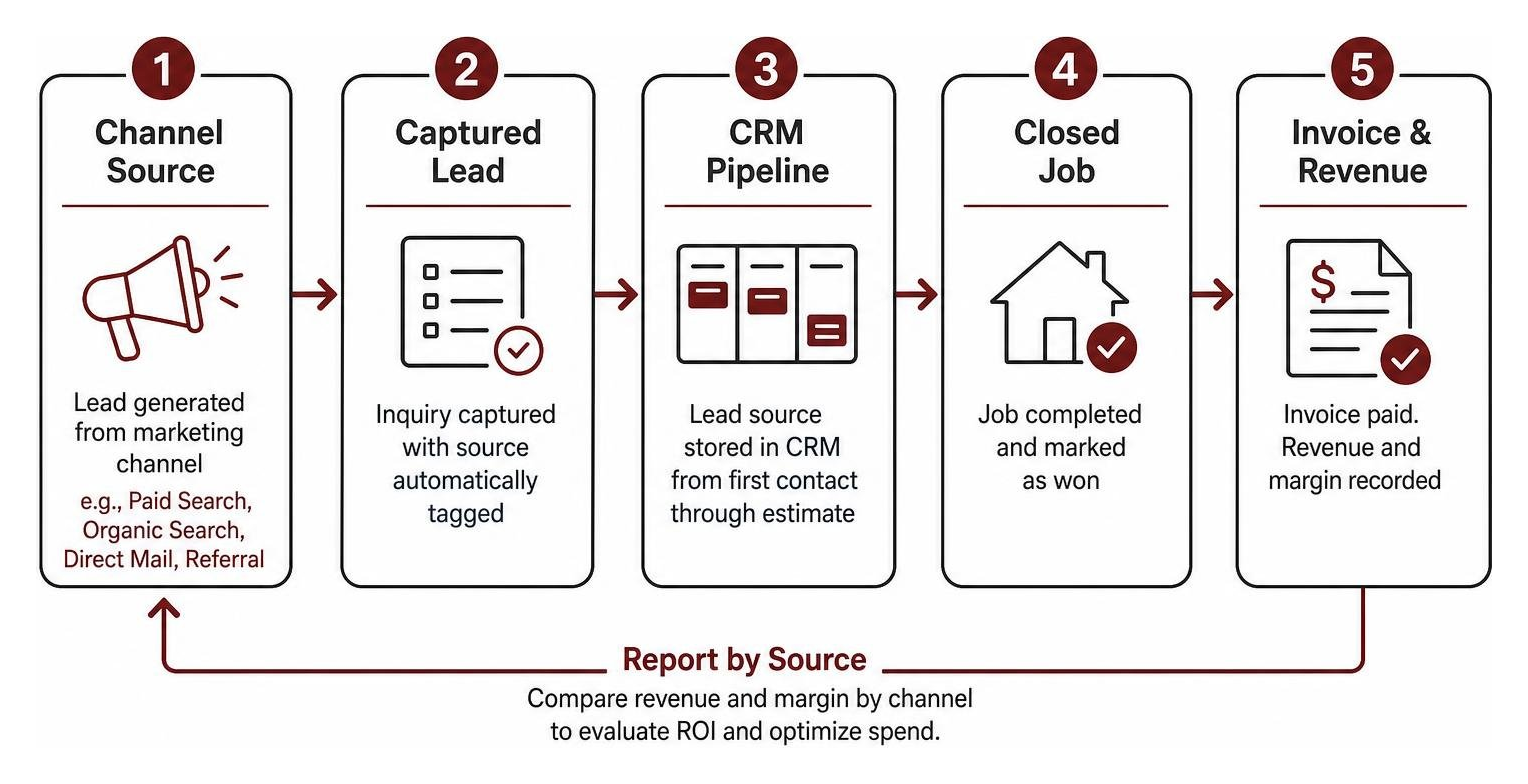
If customers call directly without clicking a trackable link, train your dispatch team to ask a straightforward intake question: “How did you first hear about us?” Log the answer in the CRM rather than relying on rough memory at the end of the quarter.
Optimizing Conversion Rates and Review Velocity to Multiply Returns
Pouring money into lead generation when your website or follow-up process is leaking is the fastest way to kill your ROI.
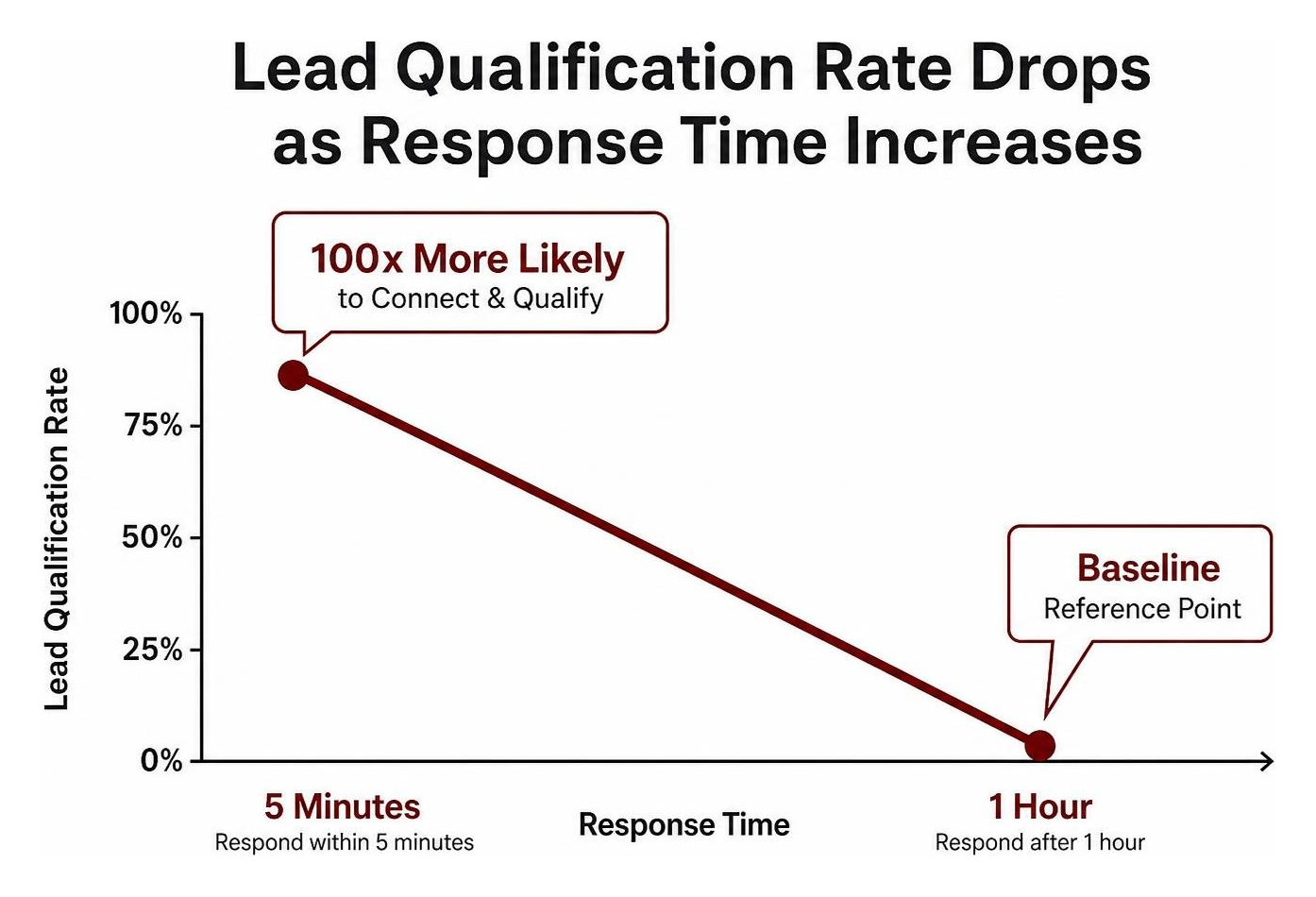
Consider response time. Companies that respond to incoming leads within 5 minutes are 100 times more likely to connect and qualify prospective customers compared to businesses that wait an hour. If a homeowner has water leaking through their drywall, they will not wait three hours for an email reply; they will call the next contractor on Google Maps.
On your website, simple visual fixes produce immediate conversion lifts. Trade websites displaying authentic photos of local crews, marked American service vans, and completed jobs convert 37% better than sites packed with sterile stock photography. Homeowners want proof that real people work on their homes.
Simultaneously, build a systematic review engine. Generating authentic customer reviews on your Google Business Profile directly improves your local map pack rankings, as detailed in our guide on local search visibility for contractors. A steady stream of 5-star reviews increases conversion rates across all your marketing channels, significantly lowering your overall CAC. Strong local visibility pairs naturally with a comprehensive SEO strategy to capture searchers who bypass paid ads entirely.
Stop Wasting Budget: Turn Measurement into Sustainable Profit
The biggest budgeting mistake contractors make is running into a “feast-or-famine” cycle. When the schedule is open, they turn on ads and buy shared leads. As soon as the crews are booked out three weeks, they cut marketing spend to zero.
Sixty days later, the backlog clears, the pipeline is bone dry, and they scramble to buy expensive emergency leads.
IRS tax data shows that the average sole-proprietor specialty trade contractor deducts only about 0.6% of receipts on advertising. That bare-minimum spending keeps businesses dependent purely on word-of-mouth. Conversely, data indicates that builders investing 4% or more of their revenue into structured marketing achieve a 29% gross markup and 9% net profit, compared to an average 20% gross markup for those who spend nothing.
Marketing is an operational investment that protects your pricing power and keeps your best technicians working year-round.
Practical Budgeting: Setting Spend by Revenue Tier and Growth Stage
The U.S. Small Business Administration recommends that small businesses generating under $5 million allocate 7% to 8% of gross revenue to marketing. However, the exact dollar amount depends on your revenue tier, average job ticket, and growth targets.
If you run a specialized trade firm and want to establish an accurate spending plan, consult our guide on contractor marketing budget planning.
| Revenue Tier | Typical Monthly Marketing Budget | Primary Channel Focus | Strategic Objective |
|---|---|---|---|
| Tier 1: Solo Contractor ($200K – $500K) | $800 – $2,500 | Google LSA, Google Business Profile, Automated SMS Review Requests | Secure immediate local call volume and establish basic local search trust. |
| Tier 2: 1-3 Trucks ($500K – $1M) | $2,500 – $6,500 | Google LSA, Targeted Paid Search, Local SEO, Branded Truck Signage | Keep existing crews consistently scheduled and build organic visibility. |
| Tier 3: 3-8 Trucks ($1M – $3M) | $6,500 – $20,000 | Multi-Channel Ads, Local SEO, Direct Mail to Target Neighborhoods, Re-targeting | Expand service territory and generate exclusive, high-ticket replacement jobs. |
| Tier 4: Enterprise ($3M – $10M+) | $20,000 – $75,000+ | Full Omni-Channel: Search, Social, AI Search, Radio/Streaming, Retention Marketing | Maintain market dominance, fuel continuous recruitment, and drive commercial contracts. |
As you scale through these tiers, tailor your messaging to your industry vertical, whether handling residential service or larger commercial projects, as seen in our work across contractor and construction marketing.
Maximizing Contractor Marketing ROI: Evaluating Agency Performance and Channel Fit
If you work with an outside marketing agency, you must hold them accountable to revenue metrics, not vanity dashboards.
Watch out for these common agency red flags:
- They hide ad accounts: The agency runs campaigns out of their own master accounts, refusing you admin access. If you leave, you lose all campaign history and pixel data. You should always own your digital assets.
- They report on clicks and impressions instead of qualified leads: A monthly report boasting 20,000 impressions is useless if your phone only rang three times.
- They cannot calculate your CAC: If your agency cannot tell you what it costs to acquire a paying customer from their campaigns, they are not tracking your pipeline.
- They lock you into long, restrictive contracts: Agencies confident in their performance do not need 12-month lock-in agreements to keep clients.
As the search landscape evolves, smart contractors are expanding beyond traditional search engines. AI-driven platforms like ChatGPT are increasingly being used by homeowners to find local trade specialists. Implementing modern search tactics, such as optimizing your brand for AI engines as covered in our breakdown of ChatGPT search tactics for contractors, ensures you stay ahead of competitors.
At The OODA Group, we provide practical, results-based marketing engines that prioritize pipeline clarity and real gross profit. Whether you need end-to-end marketing strategy or dedicated leadership through our Fractional CMO service, we build transparent systems without long-term contract traps. You can review our client results in our case studies to see how performance-driven marketing transforms trade businesses.
Taking Control of Your Marketing Returns
Measuring contractor marketing ROI is not about creating complex spreadsheets or mastering agency jargon. It comes down to basic business hygiene: track every lead to its original source, follow that lead through your CRM until the job is paid, and calculate your return based on real gross profit rather than raw revenue.
When you treat marketing as a measurable system, you stop wasting capital on low-quality leads and start allocating resources to the specific channels that keep your trucks rolling and your crews profitable.