

AEO for Contractors Starts With Clear, Verifiable Answers
AEO for contractors means making your business easy for AI search tools to understand, verify, and cite when someone asks a real question, such as, “Who installs septic systems near me?” or “What should I ask before hiring a roofer?”
Start with the practical work:
- Make your services, service area, license details, and contact information consistent everywhere.
- Build useful service pages that answer cost, timing, process, risks, and common buyer questions.
- Add accurate LocalBusiness, Service, and FAQPage schema that matches the page visitors can read.
- Publish proof: project details, safety practices, credentials, and first-hand local experience.
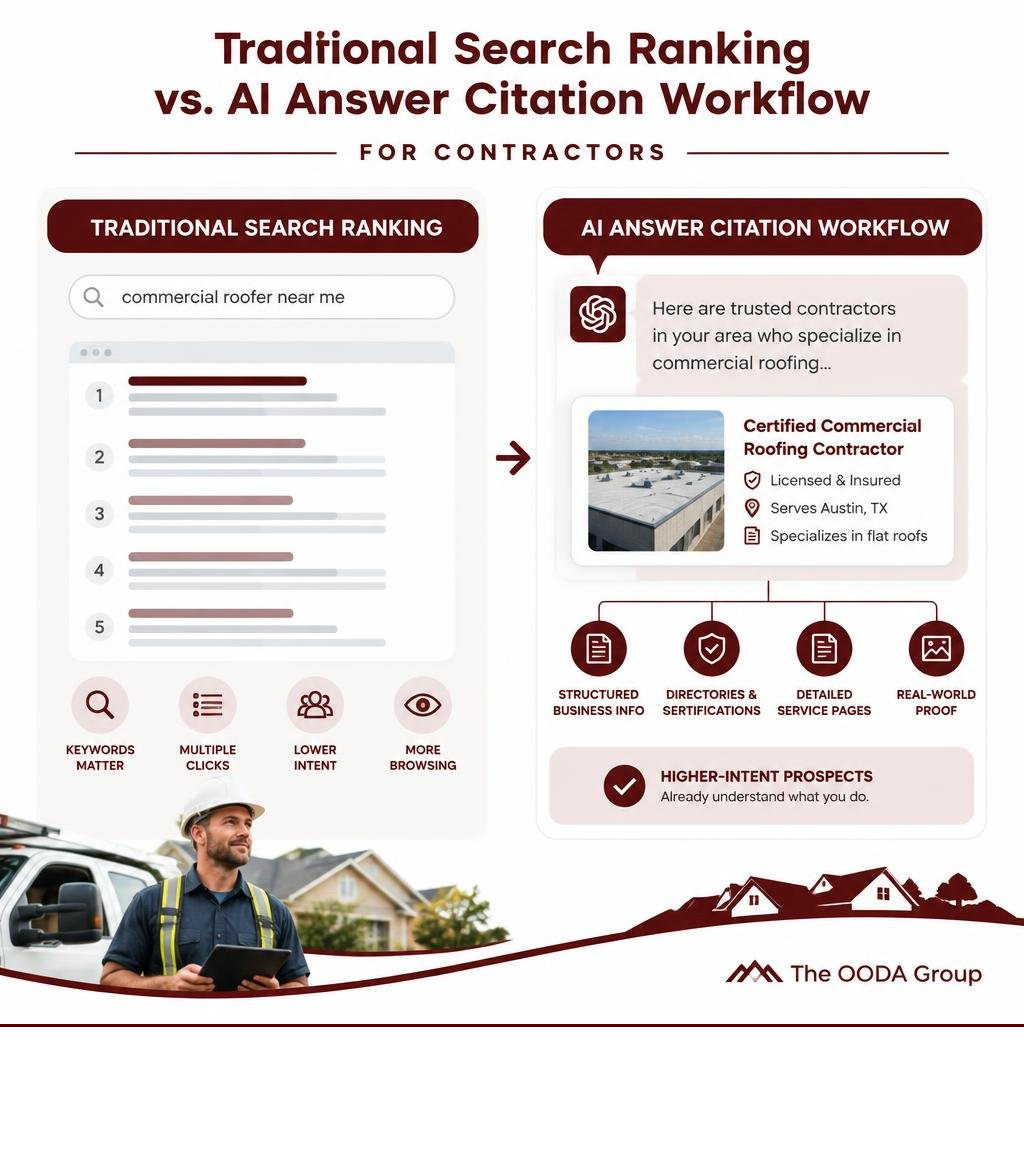
Traditional SEO is still about earning visibility in search results. AEO is about becoming a source an answer engine can use when it builds the answer itself. That can mean fewer clicks, but higher-intent prospects who already understand what you do.
There is a hard limit, though: AI search can summarize your public information and surface your company in a recommendation. It cannot inspect a hidden pipe, price a complicated job reliably, or replace a site visit and a real estimate. Treat it as a discovery channel, not a substitute for your sales process.
The OODA Group can also help qualified service businesses explore advertising on ChatGPT as these commercial placements develop. I’m Eric Turner, and next we’ll break down what answer engine optimization actually requires from a contractor business.
What Answer Engine Optimization Means for Trade Businesses
Search behavior is shifting. Homeowners and commercial facility managers are no longer just typing “commercial roofer Dallas” into a browser and browsing ten blue links. Instead, they open an AI assistant and ask conversational, multi-step questions: “I have a 15-year-old flat commercial roof in Austin showing standing water near the HVAC units. Who are the best licensed contractors to evaluate structural moisture, and what should a replacement cost?”
Answer Engine Optimization (AEO) is the discipline of structuring your company’s online footprint so large language models (LLMs) and generative search systems recognize your business as a credible, verified entity. When generative search algorithms scan the web to synthesize a direct response, they do not just look for keyword density. They pull from structured business information, authoritative directories, industry certifications, and clear technical documentation.
For companies investing in contractor & construction marketing, AEO is not a gimmick. It is the direct evolution of how search engines identify who you are, where you work, and whether your business can be trusted to handle complex trade work.
Core Mechanics of AEO for Contractors
To understand AEO, you have to understand how generative search works behind the scenes. AI engines use natural language processing (NLP) to break down user questions into intent, geography, and technical constraints. Then, using Retrieval-Augmented Generation (RAG), a technical process where the AI fetches verified external facts before writing an answer, the engine scans indexed pages to extract factual data points.
If your website contains vague sales fluff like “We are the premier service provider,” the AI has nothing factual to extract. However, if your HVAC marketing assets clearly state the specific SEER2 efficiency ratings you install, your exact emergency diagnostic fees, the brands you service (such as Trane, Carrier, or Lennox), and the counties you cover, the AI can confidently cite your company. Topical depth and first-hand operational evidence are the currency of answer engines.
Why Traditional SEO Leaves Visibility Gaps in Generative Search
Traditional local SEO focused heavily on winning a spot in the local map pack or ranking in the top three organic links. While those placements still matter, generative search interfaces frequently displace traditional rankings with zero-click answer boxes.
In these generative overviews, the engine synthesizes information from three or four sources, summarizes the answer, and cites only those businesses that provide unambiguous facts. If your plumbing marketing relies on thin, 300-word city pages stuffed with keywords, generative systems will simply skip your site in favor of a competitor whose pages document trenchless pipe lining procedures, permit workflows, and soil displacement risks.
What AI Search Can and Cannot Do: A Realistic Look at AEO for Contractors

Trade business owners are practical people. You manage cash flow, crews, equipment payments, and job schedules. You do not have time for marketing hype that promises AI will magically run your business. Let us look plainly at what AI search engines can actually accomplish for your trade company, and where their technical capabilities stop.
For specialized trades running campaigns in roofing marketing, AI search engines excel at matching homeowner problems with verified local specialists. But they cannot replace the boots-on-the-ground reality of diagnosing a complex project.
Capabilities: How Generative Engines Extract and Recommend Contractors
When an answer engine processes a prompt, it performs brand entity resolution. It checks across multiple online databases to ensure your company name, physical address, phone number (NAP), and state license numbers match perfectly.
Generative engines can:
- Match specific project requirements (such as 200-amp service panel upgrades or whole-home generator installations) to companies that demonstrate documented expertise in those specific jobs.
- Parse customer reviews across multiple review sites to summarize your reputation, punctuality, and pricing transparency.
- Verify service territory boundaries to ensure a customer in an adjacent county only receives recommendations for companies licensed and operating in that specific jurisdiction.
For example, an electrical contractor using targeted electrician marketing can capture high-value commercial inquiries simply by maintaining explicit documentation of industrial conduit bending capabilities and three-phase wiring experience on their public service pages.
Limitations: Where AI Search Engines Fall Short for Complex Trades
Despite advances in generative search, AI models have severe operational blind spots. They cannot inspect physical job-site conditions, identify hidden rot behind siding, or evaluate subterranean utility conflicts.
Most importantly, AI search engines cannot produce accurate custom bid estimates. Professional estimating requires rigorous methodology, accounting for direct labor burden, overhead, equipment mobilization, and location factors. As documented in federal estimating standards like the Cost Engineering (CE) AE120 Requirements for Project & Construction Cost Estimating Services, accurate construction estimates require granular direct cost breakdowns and thorough risk assessments. An AI engine summarizing typical square-foot costs frequently misses critical site-specific conditions like rocky soil composition, unmapped underground utilities, or non-standard electrical service drops. AI search serves as an initial introduction mechanism, not an automated estimator.
Optimizing Business Data and Technical Infrastructure for Answer Engines
Transitioning your marketing engine to capture generative demand requires aligning your technical website assets with how machines read information.
| Optimization Factor | Traditional SEO Signal | AI Answer Engine (AEO) Citation Factor |
|---|---|---|
| Content Structure | Keyword-focused copy targeting search volume | Direct, question-and-answer format with factual data points |
| Technical Markup | Basic Meta Title and Description tags | Detailed JSON-LD Schema (LocalBusiness, Service, FAQPage) |
| Entity Validation | Backlinks from external websites | Cross-platform citation consistency, licenses, and verified records |
| Trust Demonstration | Generic star ratings and review widgets | Verifiable case histories, safety audits, and project scopes |
| Audience Intent | Broad search queries (e.g., “lawn care near me”) | Complex, conversational queries detailing scope, timing, and budget |
Whether you are scaling regional landscaper marketing or managing multi-crew utility installations, structuring your data correctly ensures AI models can parse your services without ambiguity.
Implementing AEO for Contractors Across Five Core Visibility Surfaces
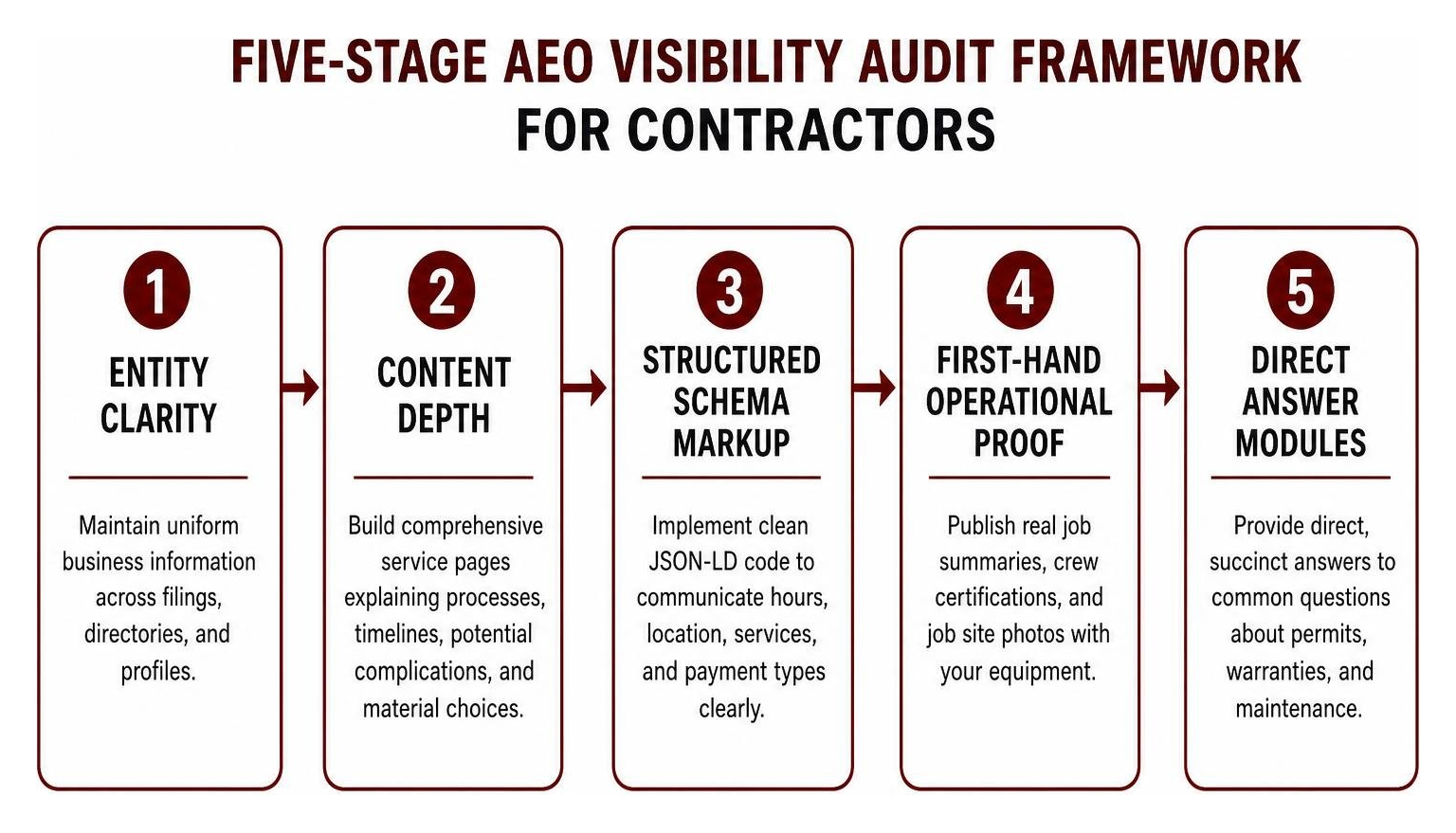
To build real generative visibility, contractor websites must execute across five fundamental surfaces:
- Entity Clarity: Maintain absolute uniformity across your business filings, Secretary of State records, Google Business Profile, and industry directories.
- Content Depth: Build comprehensive service pages that explain the step-by-step installation process, typical timelines, potential site complications, and material choices.
- Structured Schema Markup: Implement clean JSON-LD code on your site. This code acts as a translator, explicitly telling search engines your exact operating hours, geo-coordinates, specific services offered, and accepted payment types. Modern web development services must prioritize structured schema as a foundational architectural layer, not an afterthought.
- First-Hand Operational Proof: Publish real job summaries, crew certifications, and photos of your branded vehicles and equipment working on actual job sites.
- Direct Answer Modules: Include direct, succinct answers at the top of each service section addressing common buyer questions regarding permits, warranties, and maintenance requirements.
Verifiable Proof, Safety Standards, and Commercial Trust Signals
Generative search engines are programmed to minimize misinformation and hallucination risks. When a user asks for contractor recommendations, the algorithm prioritizes businesses that display verifiable trust signals, safety compliance records, and professional certifications.
Documenting compliance with rigorous industry standards, such as following structured safety programs aligned with the General Precommissioning and Mechanical Completion Checklist, signals deep operational maturity. When you detail your safety prequalifications, worker training programs, and documented field observation protocols on your public website, you provide answer engines with the verified evidence required to recommend your business for high-liability commercial and residential projects.
Frequently Asked Questions About Contractor AI Search
How does AI search differ from standard Google search for local trades?
Standard Google search returns a list of indexed links and local map listings based on keywords, domain authority, and proximity. AI search reads and synthesizes information across multiple verified sources to generate a single, direct, conversational answer. Instead of giving the user ten websites to review, the answer engine provides a summarized recommendation, citing only the specific businesses whose published data directly answers the user’s detailed criteria.
What schema markup is most important to get cited in generative search answers?
Contractors should prioritize three main schema types:
- LocalBusiness (or specific subtypes like HomeAndConstructionBusiness, Plumber, Electrician, HVACBusiness): Defines your exact business name, physical street address, service radius coordinates, license numbers, and operating hours.
- Service Schema: Clearly outlines individual service offerings, deliverables, and service areas.
- FAQPage Schema: Marks up common questions and direct answers regarding costs, permitting, project duration, and warranties, allowing generative engines to easily extract your solutions.
Can contractors advertise directly within AI search engines?
Yes. As conversational search platforms evolve, commercial ad placements and sponsored recommendations are expanding within generative environments. The OODA Group helps clients navigate advertising on ChatGPT and related AI discovery platforms, enabling trade businesses to place targeted commercial messages in front of users actively asking high-intent project questions.
Building an Actionable Engine to Capture AI-Driven Demand
Marketing spend should earn its keep. As search technology changes, established trade businesses cannot afford to rely on outdated digital playbooks that depend on thin content and manufactured signals. Competing for conversational search queries requires a clear digital foundation built on verified proof, accurate service data, and direct answers to customer questions.
For contractors evaluating their broader marketing strategy services, adapting to answer engines means prioritizing technical schema, operational credentials, and authentic project documentation.
Whether you are refining your approach to results-based SEO services or building clearer paths for prospective clients to book more jobs, focusing on transparency and verifiable facts gives answer engines the information they need to cite your business.