

How to Track Leads from ChatGPT Without Losing Them to “Direct”
To track leads from ChatGPT, use three layers: track AI referrals and UTM tags in Google Analytics 4, ask new leads how they found you, and connect those answers to booked jobs and revenue in your CRM. This catches both people who click a link in a chatbot answer and those who hear about you there but call or search for your business later.
A lead marked “Direct” may still have started with a ChatGPT recommendation. Don’t give ChatGPT credit for every direct visit, though. Ask the customer, save their answer, and check whether that lead became a job. The OODA Group can help you measure those leads and advertise on ChatGPT.
I’m Eric Turner, and we’ll start with the tracking setup you can put to work now.
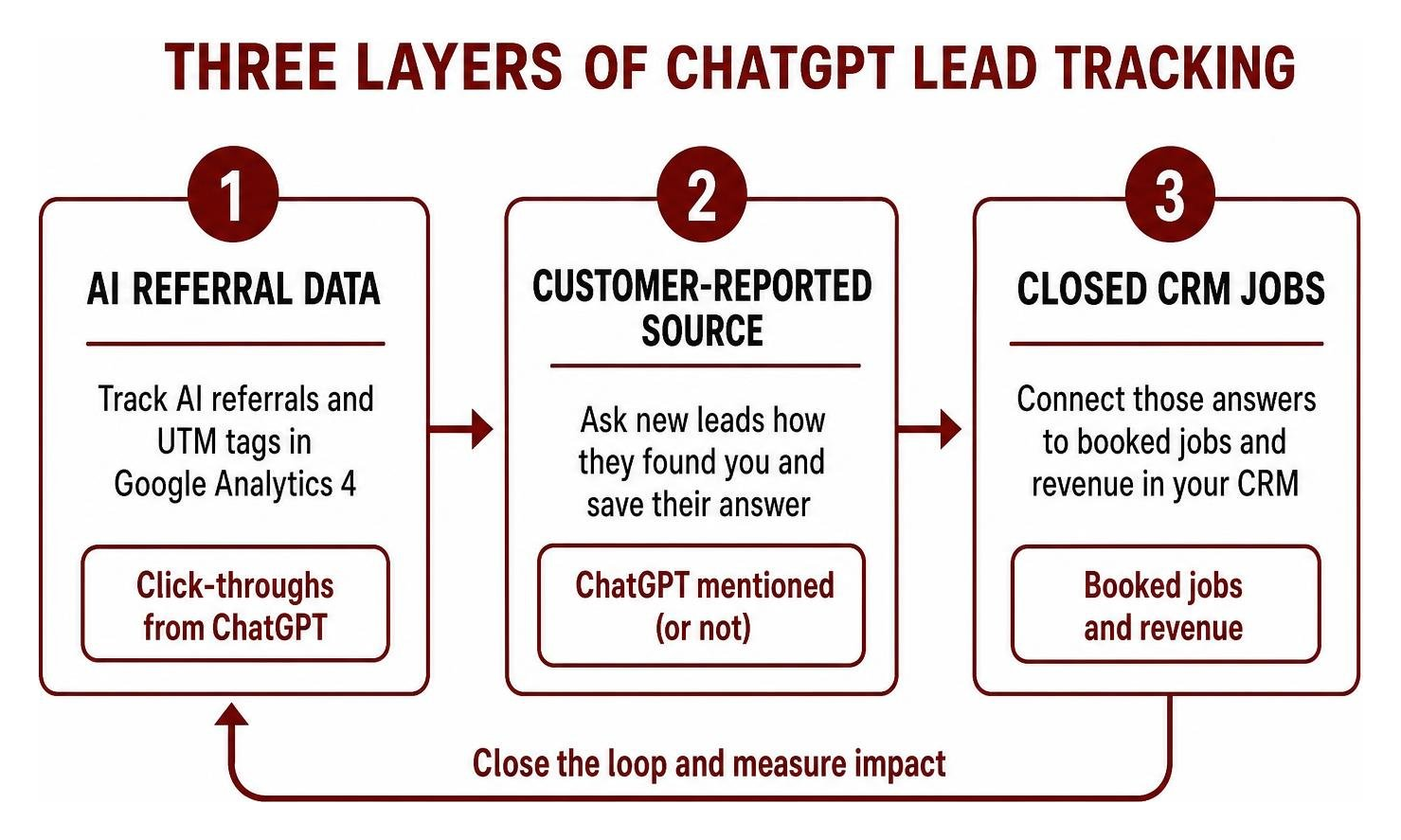
Quick look at how to track leads from ChatGPT:
- how to get recommended by ChatGPT as a contractor
- how to show up in Google AI Overviews as a contractor
- local SEO for AI search
For a deeper look at how AI platforms classify referral traffic, see Google’s Analytics Help documentation on default channel groups.
The Multi-Layer Framework: How to Track Leads from ChatGPT
Conversational search is reshaping inbound marketing. In October 2026, roughly 12% of all ChatGPT sessions carry explicit commercial intent, representing around 4 billion monthly searches from buyers looking for local services and B2B providers. Recent industry benchmarks show that visitors referred by artificial intelligence platforms convert at an average rate of 15.9%, compared to just 1.76% for standard Google organic search.
Despite this conversion advantage, most of this traffic disappears into standard analytics platforms under “Direct” or “None.” When an AI tool provides an answer inside a desktop or mobile application, the user environment frequently strips the referral header (the browser data snippet showing the previous webpage URL). If a homeowner asks ChatGPT for the best local electrician, reads your company name, and types your URL directly into their phone or taps an unformatted citation link, standard web tracking sees a direct visitor with zero historical context.
To overcome this blind spot, we use a three-tier attribution framework that bridges technical web data and real-world sales conversations:
- Digital Referral and Campaign Capture: Configuring analytics platforms to catch explicit referral domains and standard OpenAI tracking tags.
- First-Party Declared Attribution: Capturing buyer self-reporting on web forms, chat widgets, and inbound phone intake scripts.
- CRM Pipeline Integration: Connecting verified AI touchpoints to closed-won revenue, booked estimates, and actual dispatched jobs.
Using smart contractor marketing tactics for ChatGPT builds your authority across large language models, but pairing that presence with this framework ensures your marketing dollars remain accountable.
Technical Setup: How to Track Leads from ChatGPT in Analytics and CRMs
Setting up digital tracking requires configuring your web properties to isolate AI visitors before they get lumped into generic referral or direct buckets.
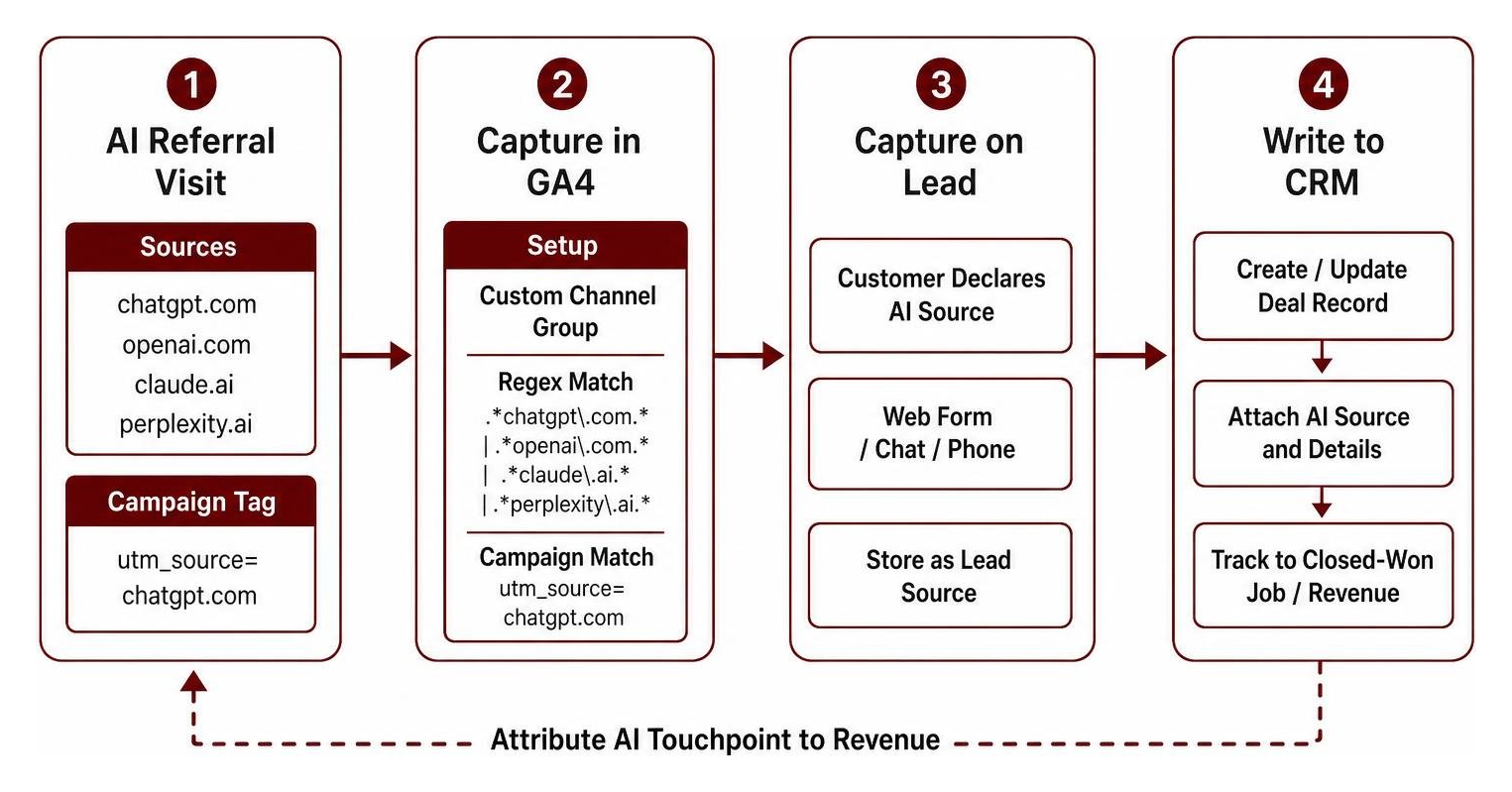
1. Configure Custom Channel Groups in Google Analytics 4 (GA4)
GA4 contains an AI Assistant channel, but custom channel groups give you control over historical data and emerging platforms. Create a custom channel group positioned above your generic “Referral” channel using a regular expression (regex) rule to capture incoming traffic:
- Match regex source patterns:
.*chatgpt\.com.*|.*openai\.com.*|.*claude\.ai.*|.*perplexity\.ai.* - Match campaign parameter strings:
utm_source=chatgpt.com
OpenAI automatically appends utm_source=chatgpt.com to many outbound citation links. Creating an explicit rule ensures these visits are grouped cleanly.
2. Configure Native CRM Attribution (HubSpot & Service CRMs)
Modern customer relationship management (CRM) platforms identify AI traffic through referring domains. In HubSpot, contacts whose initial session comes from recognized platforms populate under “AI Referrals.”
To capture the complete picture, implement custom properties within your CRM:
- Create a contact property named
Original Source Drill-Down 3orAI Referral Platform. - Use hidden form fields on your landing pages to scrape URL parameters on form submission.
- Ensure your tracking integrates cleanly with building resilient search strategies for AI engines so your technical structure supports accurate attribution.
3. Implement Server-Side Tracking
Client-side JavaScript tags can be blocked by browser privacy controls or stripped inside app webviews. Server-side tagging (via Google Tag Manager Server Container) reads HTTP request headers directly from the web server, logging incoming referral strings from AI domains even when client-side scripts fail to execute.
Beyond Direct Traffic: How to Track Leads from ChatGPT with First-Party Attribution
Relying exclusively on click tracking leaves a massive gap. In conversational search, over 70% of brand discovery happens through zero-click mentions. A prospect asks ChatGPT for a commercial roofing recommendation, receives your business name alongside two competitors, closes the chat, and searches for your brand name or dials your main phone line three days later. Last-click attribution will wrongly credit that revenue to organic brand search or direct traffic.
First-party attribution solves this by collecting verified discovery data directly from the prospect at the point of inquiry.
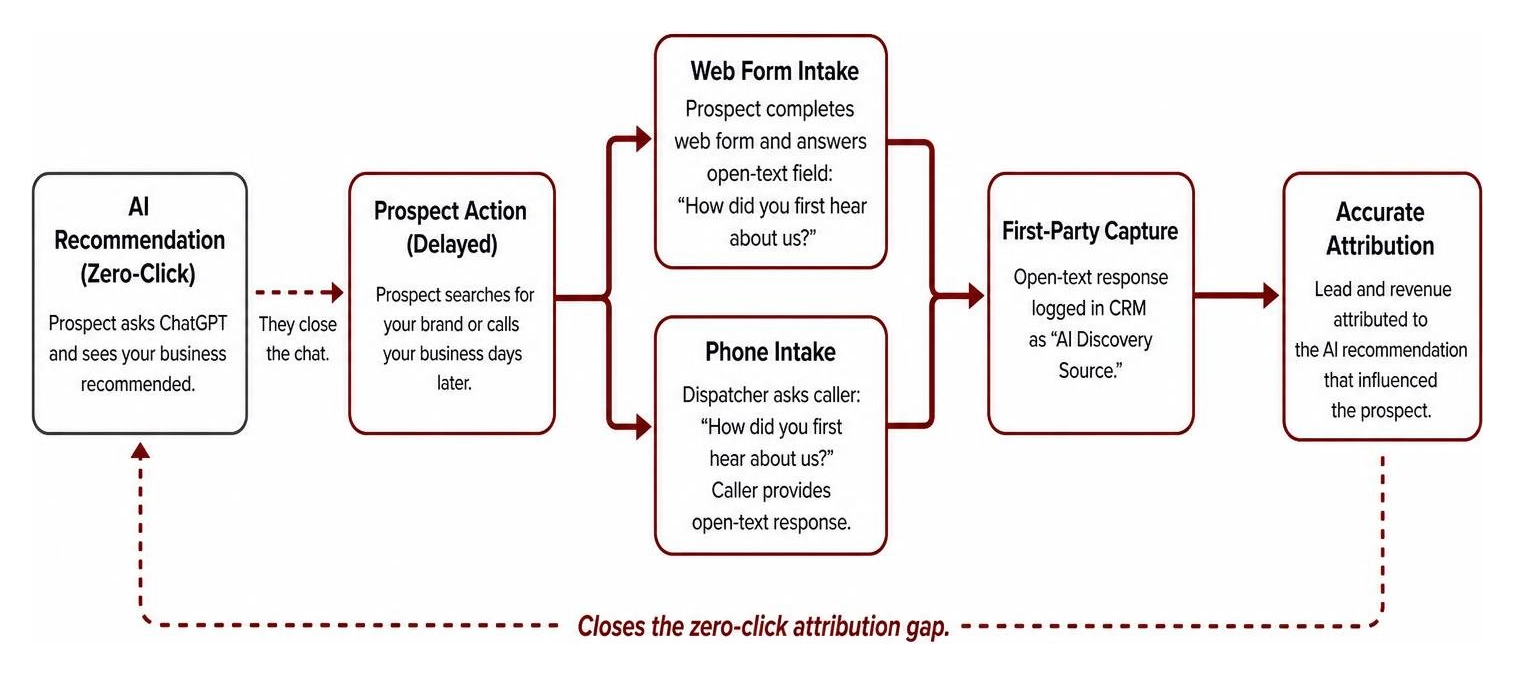
Practical Steps for First-Party Data Capture:
- Add an Open-Text Intake Field: Replace rigid dropdowns with an open-ended “How did you first hear about us?” field on web forms. Dropdowns force users to select broad categories like “Google,” while open text allows prospects to type “ChatGPT recommended you for electrical panel upgrades.”
- Train Phone Dispatchers: Script customer service representatives to ask every new caller where they heard about the company. Log exact phrases in your field service management software.
- Support AI Search Recognition: Reinforce your brand’s digital identity using structured entity optimization on your Google Business Profile and website schema. Clean entity data makes it easier for AI models to serve accurate company details to prospects who search for you later.
Manual Methods vs. Automated Software for AI Lead Attribution
As search habits change, businesses must decide between manual measurement workflows and dedicated AI attribution platforms. Specialized tracking tools monitor target prompt queries across models, detecting brand citations and estimating search share.
| Attribution Feature | Manual Analytics & CRM Setup | Automated AI Monitoring Software |
|---|---|---|
| Primary Data Source | GA4 Custom Channels, UTMs, Form Surveys | Synthetic Prompt Probing, API Log Analysis |
| Zero-Click Brand Visibility | Captured only via self-reported surveys | Automated brand citation and sentiment tracking |
| Setup Cost & Complexity | Free (Internal configuration time) | $100–$500+ monthly subscription fees |
| Data Accuracy | High for direct clicks; directional for surveys | High for model visibility; estimated for clicks |
| Share of Model Tracking | Manual testing required across prompts | Automated calculation across thousands of prompts |
| Operational Overhead | Ongoing manual CRM reviews and audits | Automated dashboard alerts and monthly reports |
Manual methods provide clean, verified conversion data at zero software cost. Automated platforms excel at top-of-funnel brand visibility analysis, alerting you when competitors start overtaking your citation share in local AI answers.
Core Metrics to Prove Return on Investment to Stakeholders
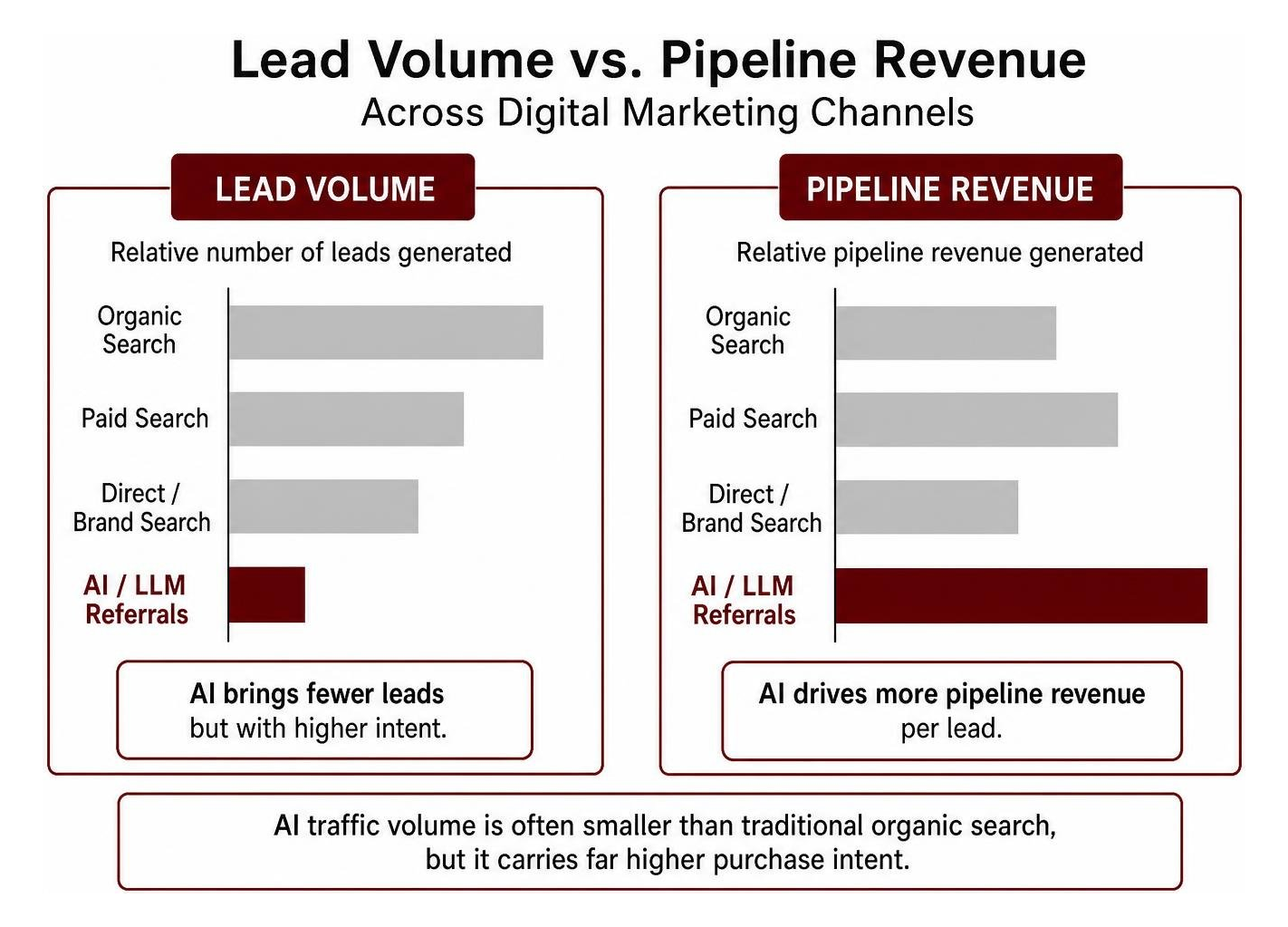
When reporting marketing performance to business partners or executive leadership, raw click volume tells an incomplete story. AI traffic volume is often smaller than traditional organic search, but it carries far higher purchase intent.
Focus your reporting on four core commercial metrics:
- LLM Conversion Rate: The percentage of AI-referred visitors who submit a form, book an estimate, or initiate a call compared to standard search traffic.
- Citation Share (Share of Model): The percentage of category-specific prompts (for example, “best commercial HVAC contractor near me”) where your business is cited in recommendations across major models. Week-over-week citation counts can fluctuate by roughly 50% due to continuous model updates, so evaluate trends over 90-day windows.
- Pipeline Value & Revenue per AI Lead: The average contract value of deals originating from AI channels compared to paid search or social media. Evaluating this helps when measuring customer acquisition costs to ensure high-intent channels receive proper budget allocation.
- Assisted Conversion Volume: Multi-touch conversion data demonstrating how often an AI interaction served as an early touchpoint before a direct or phone-call conversion.
Turning AI Attribution into Revenue for Trade Businesses
Attribution is only valuable if it drives smarter business decisions. When you track which AI platforms generate your highest-margin service calls, you can shift your budget from generic visibility campaigns into targeted local authority assets that search models trust.
At The OODA Group, we provide results-based marketing for trade contractors and professional service firms. We build high-converting websites, manage direct ad campaigns across emerging channels, and provide proven SEO services designed to win visibility across both traditional search engines and conversational AI models.
We can help you track your leads across modern search platforms and manage targeted advertising on ChatGPT to keep your pipeline full of high-value jobs. Contact our team today to turn modern search traffic into measurable revenue.