

Why Your Google Business Profile Matters in AI Search
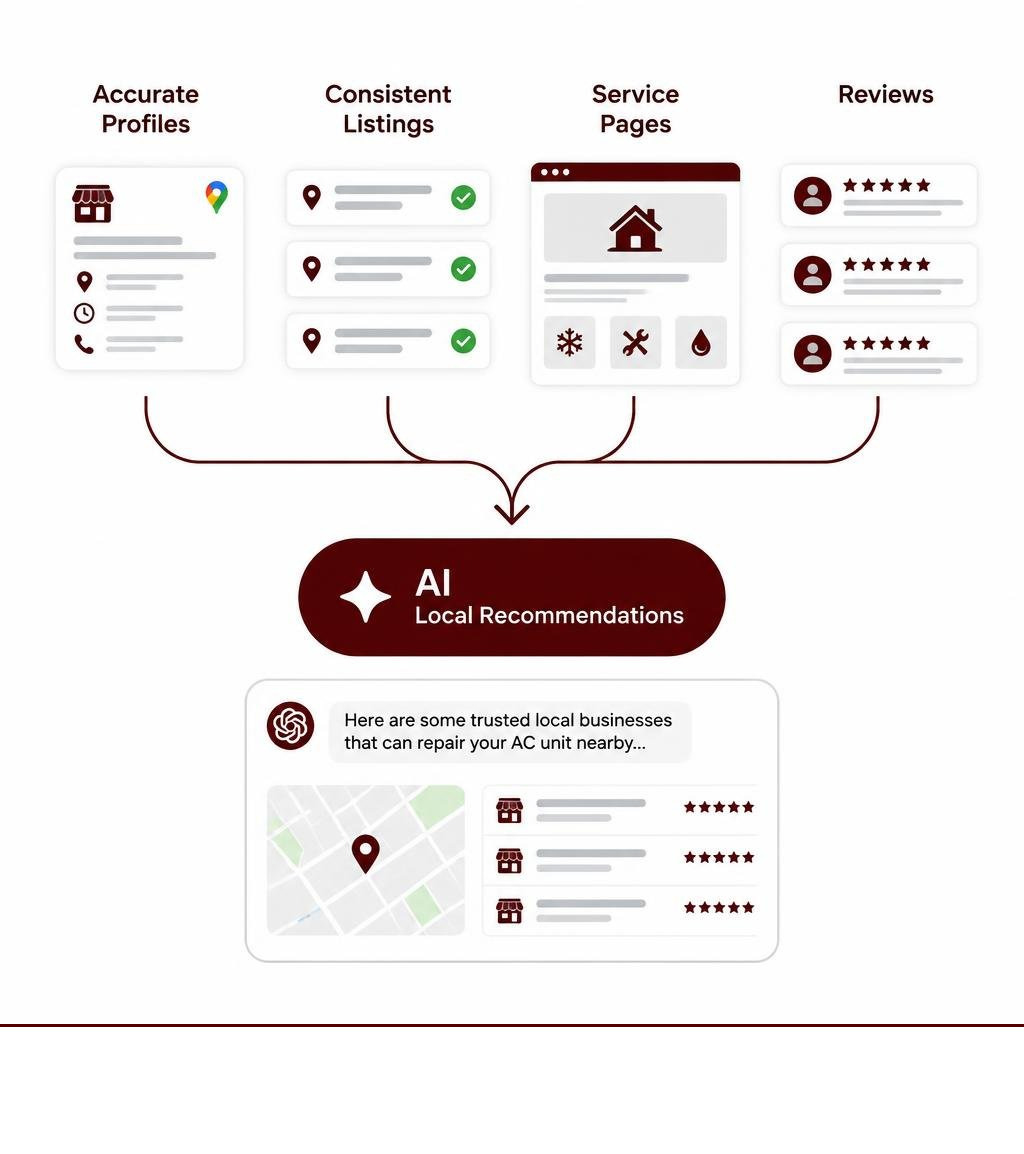
To improve local SEO for AI search, start with facts an AI tool can check: your business name, service area, hours, services, and contact details. Keep them current in your Google Business Profile, match them on your website and other listings, and back them up with specific service pages and genuine customer reviews.
A top spot in the local map pack does not guarantee a mention in an AI answer. When someone asks who can repair an AC unit nearby, the answer may draw on several sources before they ever visit a website. Make it easy to understand what you do, where you work, and why customers trust you.
The OODA Group can also help with advertising on ChatGPT, which is separate from earning organic recommendations. I’m Eric Turner, and this guide starts with the business facts you can fix today.
Quick local SEO for AI search terms:
- AEO for contractors
- how to get recommended by ChatGPT as a contractor
- how to show up in Google AI Overviews as a contractor
The Core Pillars of Local SEO for AI Search and Entity Authority

Traditional search engines matched typed keywords against page text. Generative AI models operate differently: they rely on an underlying knowledge graph (a giant map of verified real-world entities, places, and connections). For an engine like ChatGPT, Perplexity, or Google AI Overviews to recommend your company, it must first recognize your business as a verified entity with consistent attributes.
Large language models read your digital presence using semantic triples: clear, machine-readable statements structured as subject-predicate-object (for example, “[Apex Plumbing] [provides] [tankless water heater repair] in [Dallas]”). When these relationships are unmistakable across the web, AI engines gain confidence in recommending your business.
| Traditional Local Pack Ranking Factors | Generative AI Engine Citation Signals |
|---|---|
| Keyword density on page | Direct, extractable 120–180 word answer blocks |
| Backlink quantity and domain metrics | Factual entity verification across directories |
| Proximity to the searcher’s pin | Granular service-area validation and structured data |
| Total review count | Semantic sentiment and detailed review attribute depth |
| Basic Google Business Profile categories | Omnichannel NAP consistency and multi-platform presence |
Optimizing Google Business Profile as the Primary Data Layer for Local SEO for AI Search
Your Google Business Profile (GBP) serves as the primary factual foundation for AI local answers. If your primary category is vague or your secondary categories conflict with what is on your website, AI engines treat that contradiction as uncertainty. An uncertain AI model defaults to recommending a competitor whose details leave zero doubt.
Keep your primary category tightly aligned with your main revenue driver, and use specific secondary categories for related specialties. Add exact operating hours, precise service-area zip codes, and comprehensive service menus that mirror the wording on your website. Visual proof also reinforces machine recognition: profiles with regularly uploaded photos receive 42% more requests for directions and 35% more click-throughs. For a deeper look at structuring this information, see our guide on Google Business Profile structured entity data.
Technical Entity Precision: Schema Markup and NAP Consistency for Local SEO for AI Search
Schema markup is structured code placed on your website that translates your business information into machine-readable format. Instead of forcing an AI crawler to guess what your page is about, schema explicitly labels your business name, address, phone number (NAP), operating hours, pricing range, and specific services offered.
Clean entity schema combined with rock-solid directory consistency delivers an estimated 2.4x lift in AI visibility. Ensure your LocalBusiness, Service, and AggregateRating JSON-LD markups match your external citations identically. This consistency must extend across every major mapping and data platform:
- Bing Places (which feeds directly into engines like ChatGPT)
- Apple Business Connect
- Mapbox and Foursquare
- Industry-specific trade directories
Any mismatch in your phone number, suite address, or company naming structure creates confusion that can disqualify you from being cited. Learn more about foundational practices in our breakdown of building local search visibility for contractors.
Content Architecture, Query Fan-Out, and Answer Engine Optimization (AEO)
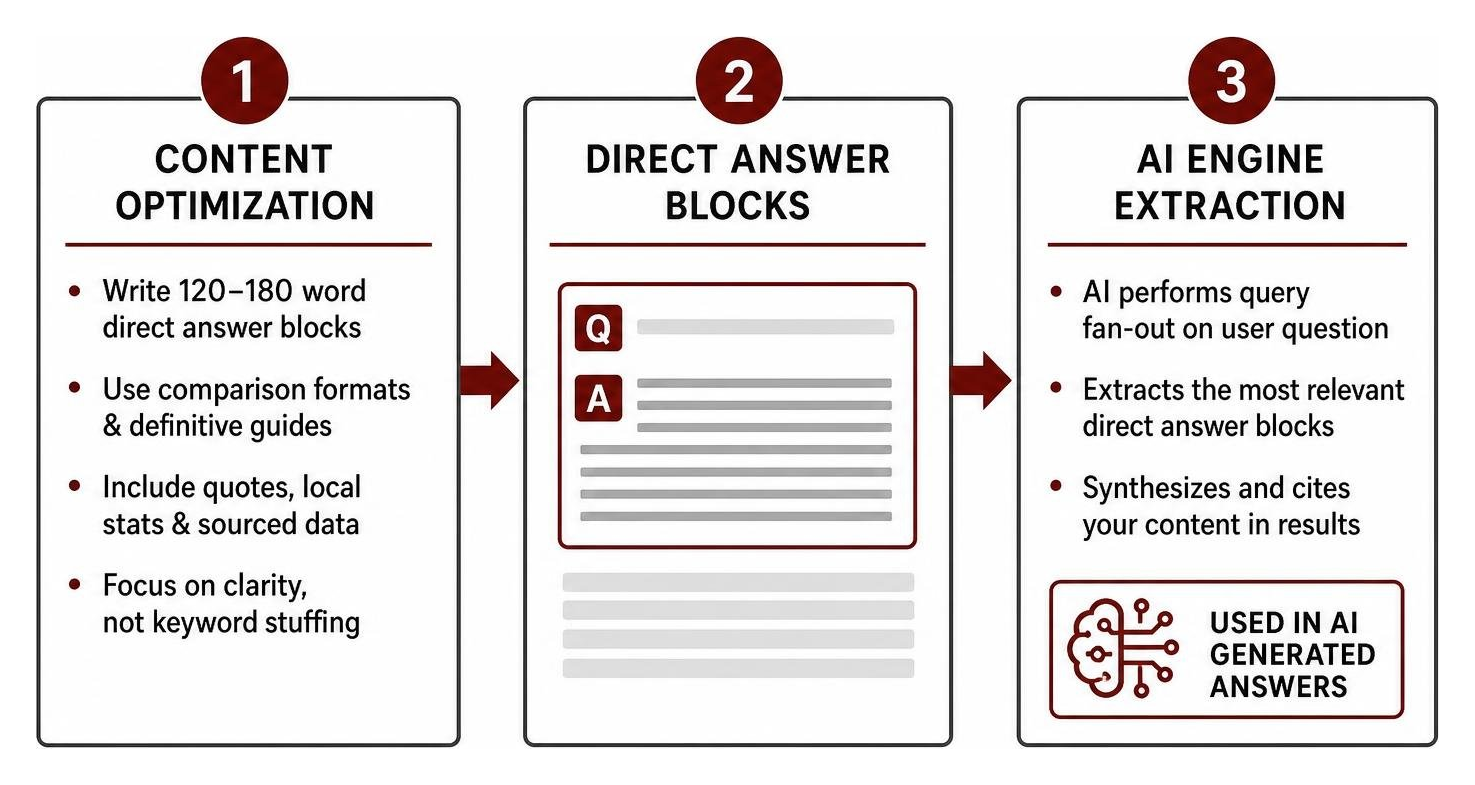
Answer Engine Optimization (AEO) means organizing your content so an AI engine can extract a complete, direct answer in seconds. When someone asks a complex local question, AI engines use query fan-out: breaking a single prompt into multiple underlying sub-questions (pricing, availability, warranty, local code requirements) to synthesize an answer.
To capture these citations, write distinct 120–180 word answer blocks at the top of your service sections. Structure your content around comparison formats (which account for roughly 33% of AI citations) and definitive guides (accounting for about 15%). Incorporate authoritative elements into every page:
- Expert and customer quotations (associated with a ~41% lift in AI visibility)
- Specific, verified local statistics (associated with a ~33% visibility lift)
- Sourced citations and reference data (delivering an approximate 28% visibility lift)
Avoid old-school keyword stuffing, which actually drops AI visibility by about 8%.
Scaling Your AI Search Strategy and Measuring Real ROI
If you manage multiple locations, copying and pasting identical page templates across different city URLs will fail in AI search. High-performing multi-location companies govern core brand standards centrally while delivering 60% to 70% unique, hyperlocal content for each individual service area. Mention regional building codes, common architectural styles, local climate challenges, and specific neighborhood projects.
Scaling this without chaotic overhead requires tracking your presence where decisions actually happen. For practical strategies on maintaining digital authority across markets, review our guide to tactics for contractor marketing for ChatGPT search, and consider how this fits into your overarching marketing strategy.
Reputation Signals and Customer Review Sentiment Across Multi-Channel Networks
AI engines evaluate the semantic sentiment within customer reviews rather than looking strictly at your total star rating. A detailed review that notes a fast weekend response time, names the part that was replaced, and mentions a clear warranty explanation gives an AI model verified facts about your emergency availability and repair scope.
Prompt your satisfied customers to mention the specific service performed, the technician’s name, and the neighborhood. Respond to every review professionally, adding operational context in your replies. Expanding your presence across an extended publisher network (including Yelp, the Better Business Bureau, and active discussions on Reddit and YouTube) can produce up to a 186% increase in clicks from Google, as multi-source consensus reinforces your business’s legitimacy.
Tracking Generative Citations, Conversion Actions, and Performance Execution
Measuring AI search requires moving beyond traditional blue-link ranking reports. Track your generative share of voice by running consistent localized prompts across platforms like Perplexity, ChatGPT, and Google AI Overviews to monitor how often your brand is cited. Focus on bottom-line conversion actions: direct phone calls, booked estimates, and qualified form submissions originating from AI referrals.
At The OODA Group, we provide SEO services built on a performance-driven engine without long-term contracts. We also help service contractors manage targeted advertising on ChatGPT, ensuring your brand captures high-intent local demand across both organic citations and emerging conversational ad channels. Explore our blog for ongoing playbooks on staying ahead in modern search.