
Core Blueprint: How to Get Recommended by ChatGPT as a Contractor
To get recommended by ChatGPT as a contractor, make it easy for search systems to confirm three things: who you are, what jobs you actually do, and why customers can trust you. Keep your public business details consistent, publish useful service information, and earn legitimate third-party validation. There is no trick that forces an organic recommendation, but a clear and credible web presence gives AI systems better evidence to work with.
A homeowner may ask a detailed question, such as whether an electrician handles panel upgrades in older homes or whether an HVAC company offers emergency service in a specific area. An AI answer has to connect the company name, trade, location, services, and reputation before it can responsibly suggest a business.
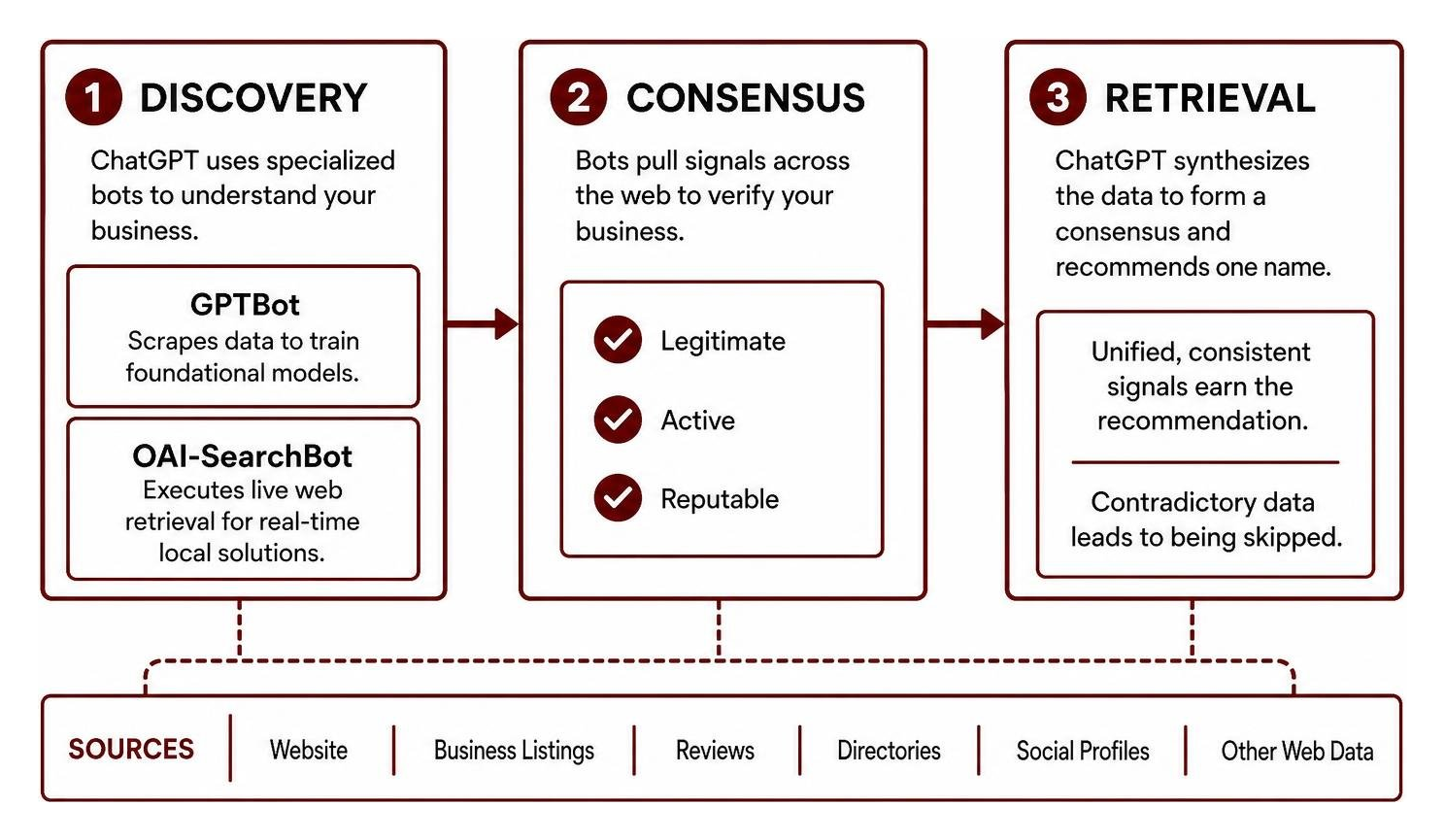
Think of this as a verification problem, not a popularity contest. If your site says you install commercial boilers but your listings, reviews, and service pages tell a different story, the evidence is muddy. If those sources reinforce the same specialty and service area, your business is easier to understand.
| Traditional local search focus | AI recommendation focus |
|---|---|
| Ranking for short search terms | Matching detailed questions to clear business facts |
| One primary profile | Consistency across your site, listings, reviews, and trusted mentions |
| A long list of results | A short set of options with supporting context |
The goal is not to chase every directory or manufacture praise. It is to make the information a real prospect needs available, accurate, and specific. The next section turns that goal into four practical priorities.
The 4-Pillar Blueprint on How to Get Recommended by ChatGPT as a Contractor
The first section explained why AI recommendations depend on clear, corroborated information. Here is the operating plan: make your business easy to verify, easy to understand, and easy to trust. None of it is glamorous. It is also the work most contractors skip while hunting for a shortcut.
1. Build a Consistent Business Record Across the Web
Start with the basics: your business name, address, and phone number, often called NAP, should match everywhere a customer or search platform can find you. That includes your website, Google Business Profile, Bing Places for Business, Apple Business Connect, licensing records, and relevant trade directories.
Do not treat those listings as a one-time chore. Review your service categories, hours, service area, photos, and phone number quarterly. A contractor with conflicting information across major listings creates doubt before an AI system ever gets to the quality of the work. Great crews lose good jobs this way every day, not because the work is bad, but because the facts look sloppy online.
2. Make Your Website Easy for Search Systems to Read
Schema markup is behind-the-scenes website code, also called structured data, that labels important facts so search engines can interpret them correctly. Think of it as clear tags on a job folder: this is the business, these are its services, this is the service area, and these are common customer questions. It does not guarantee a recommendation, but it reduces confusion about what your company actually does. That is valuable because vague websites make every system work harder, including the homeowner trying to decide whether to call.
For contractors, useful schema may identify the company, the services it offers, its locations, and common questions customers ask. Build individual service pages around real work your crew wants more of. Explain who the service is for, what the process involves, which areas you serve, and what can affect price or timing. Give a direct answer near the top, then add the useful detail a property owner needs to make a decision. A thin page stuffed with “best contractor near me” is not proof of expertise. It is just noise wearing a hard hat.
Also check that your website is not blocking important crawlers, which are automated programs that read public web pages for search and AI systems. OpenAI publishes guidance for website owners about GPTBot and OAI-SearchBot; Bing provides its own crawler guidance through Bing Webmaster Tools. Your developer should review robots.txt, security rules, and CDN settings before assuming a bot can access the site. A CDN, or content delivery network, is a service that helps a site load quickly, but its security settings can sometimes block legitimate crawlers by mistake.
3. Publish Proof of Specific Expertise
Generic “we do it all” pages rarely make a contractor memorable. Publish material that proves your specialty: a project breakdown, a cost guide with clear assumptions, a permitting FAQ, or a troubleshooting article written around a problem your team solves regularly.
For example, an HVAC company may be more useful to a homeowner searching for a heat-pump retrofit if it explains equipment options, electrical requirements, likely scheduling constraints, and local rebate considerations. That is more credible than repeating “best HVAC contractor” until the page becomes unreadable. Specificity wins because it sounds like a company that has actually done the work.
4. Earn Independent Validation
Your website is only one part of the picture. Keep association memberships, local chamber listings, licensing profiles, and legitimate customer reviews current. Where it makes sense, offer regional publications or trade organizations accurate project data and expert commentary. Independent mentions help reinforce the real-world facts behind your marketing.
Organic recommendations and paid placement are separate. Contractors can also explore advertising in ChatGPT where it fits their market and budget, but ads do not replace a credible business record or helpful service content. The OODA Group can help contractors evaluate both their organic visibility and appropriate ChatGPT advertising opportunities.
Measuring AI Visibility, Avoiding Common Pitfalls, and Scaling Growth
AI visibility is not a set-it-and-forget-it project. Review the information your business publishes, watch for changes in your listings, and measure whether you are appearing for the kinds of jobs you want. If you only look at this when leads are slow, you are already playing catch-up.
Use a small, consistent set of realistic prompts each month, tailored to your trade and service market. For example:
- “Which licensed commercial HVAC contractors serve downtown Dallas?”
- “I need an emergency electrician in East Austin for an older home. Who should I call?”
- “Can you recommend a kitchen remodeling company near 75201?”
Record whether your company is mentioned, whether the description is accurate, and which sources appear to support the answer. Bing Webmaster Tools can also help you monitor how Bing discovers and indexes your site. Do not obsess over one screenshot or one prompt result. Look for patterns, then fix the underlying evidence.
Avoiding Crawler Blocks, Keyword Stuffing, and Outdated Content Errors
Contractors commonly create their own visibility problems by:
- Blocking crawlers: Ask your developer to check that your firewall, CDN (content delivery network, a system that speeds up site delivery), and
robots.txtrules do not unintentionally block search crawlers. - Stuffing keywords: Repeating “best plumber near me” does not prove expertise. Write clear explanations, use natural headings, and include the details a customer needs. If a phrase makes the page sound ridiculous when read aloud, it probably does not belong there.
- Leaving pages stale: Update service areas, credentials, operating hours, pricing assumptions, and project examples when they change. Old information does not make you look established; it makes you look unattended.
- Blurring multiple locations: Give each office or service area accurate location details and relevant service information so customers and systems do not confuse one market with another.
Organic Visibility and ChatGPT Advertising
Organic recommendations depend on the quality and consistency of information available across the web. Advertising is separate: it can be a useful way to reach an audience, but it does not substitute for accurate listings, strong service pages, or good customer experience. Buying attention is not the same as earning trust.
The OODA Group helps contractors evaluate their organic AI-search visibility and where ChatGPT advertising may make business sense. If you want an honest view of the gaps between your website, listings, and lead goals, explore our SEO services.