
Calculate the Real Cost of Winning a New Customer
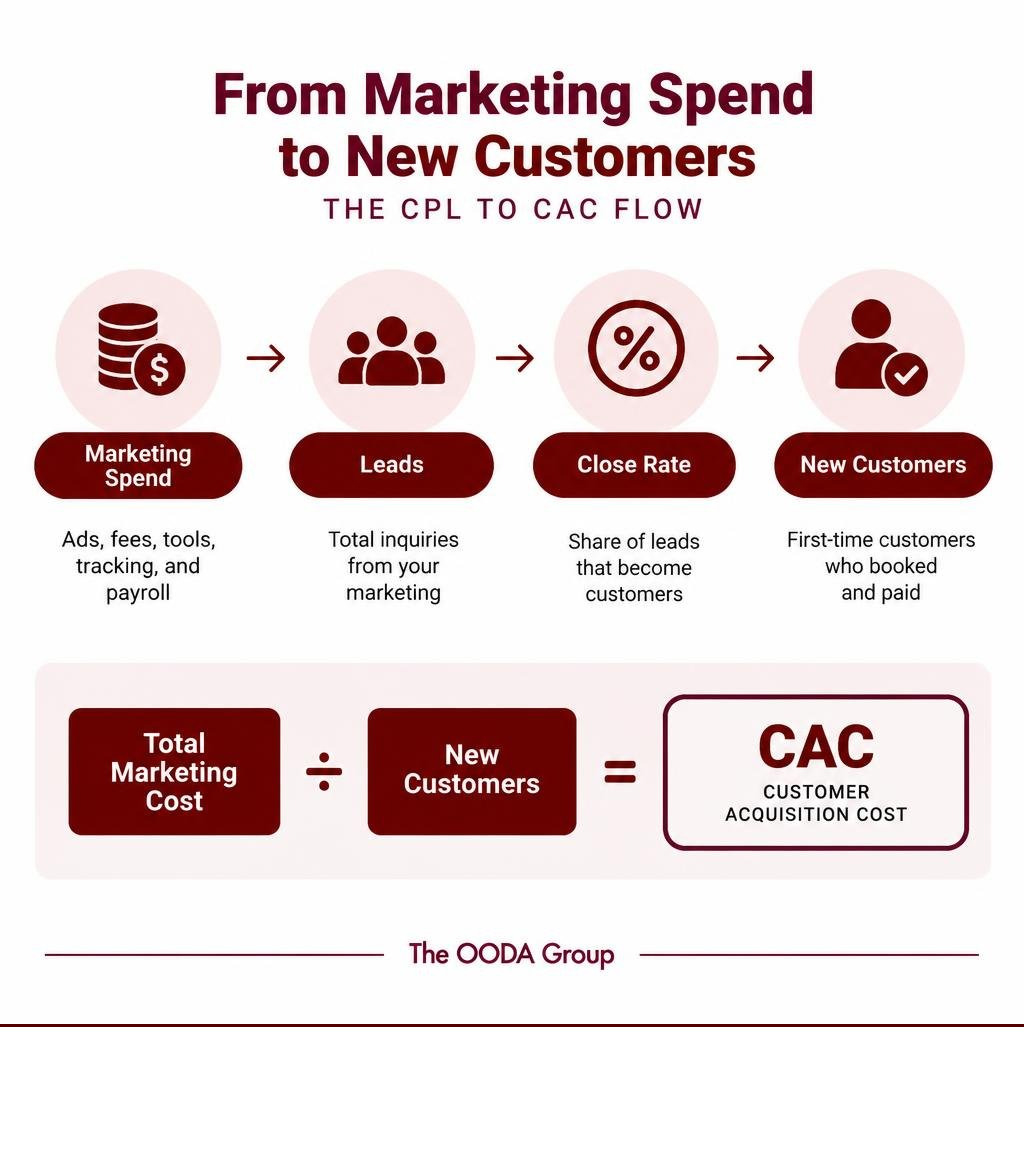
To calculate customer acquisition cost for contractors, divide the full cost of generating and closing new business by the number of new customers who actually booked and paid.
- Add ad spend, agency fees, lead-platform fees, call tracking, and the payroll cost tied to marketing and lead handling.
- Count only first-time customers won during the same period.
- Divide total cost by those new customers.
- Compare the result by channel, not just as one blended number.
A $40 lead is not automatically a good lead. If only 1 in 10 leads closes, that lead source produces a $400 customer acquisition cost before you account for the rest of the sales and marketing overhead. Conversely, a higher-cost lead that closes at a much higher rate can actually produce a lower final acquisition cost.
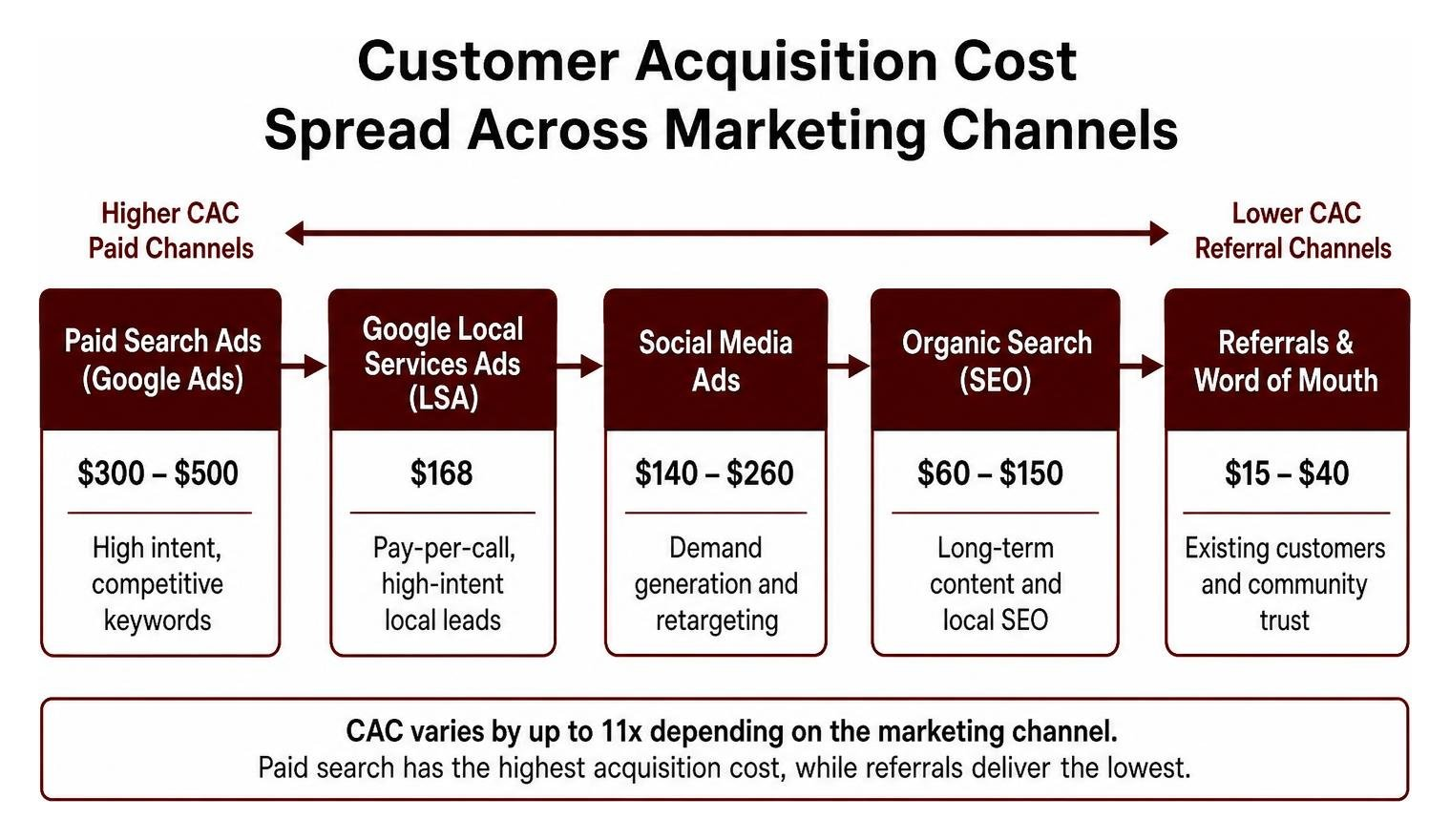
That distinction matters. Word-of-mouth referrals often produce new customers at a negligible direct cost, while shared third-party lead networks can cost hundreds of dollars per booked job once poor close rates are factored in. Direct search channels like Google Local Services Ads often sit somewhere in between. The gap is not a rounding error. It is often the difference between a dependable pipeline and a busy team producing razor-thin margins.
Your job is not to find the cheapest lead. It is to find the marketing channels that bring in the right jobs at a cost your ticket value, gross margin, and crew capacity can support.
I am Eric Turner, and the next sections will show you how to calculate CAC accurately before you spend another dollar based on a misleading lead report.
Calculating the Real Customer Acquisition Cost for Contractors: Step-by-Step
Let’s cut through the spreadsheet gymnastics. Most marketing reports celebrate metrics that do not pay the supply house bill. Cost per impression, click-through rates, and even raw phone inquiries mean nothing if the cash drawer remains empty.
To determine true CAC (Customer Acquisition Cost), use this basic mathematical foundation:
CAC = Total Direct & Indirect Acquisition Expenses ÷ Total New Paying Customers Acquired

To make this formula accurate, gather every expense required to land a paying customer over a specific period (such as a given month, quarter, or year):
- Direct Advertising & Platform Spend: Media costs for Google Ads, Local Services Ads (LSA), social platforms, print mailers, and lead platforms like Thumbtack or Angi.
- Agency Fees & Software Tools: Retainers paid to digital growth partners, call-tracking subscriptions, and website hosting. Investing in functional web development serves as a baseline digital asset that supports conversion across all channels.
- Lead Handling & Estimating Wages: The proportional pay of dispatchers and customer service reps who handle inbound inquiries, alongside sales commissions or estimator payroll tied directly to bidding new jobs.
- Creative & Local Signage: Photography, job-site yard signage, and vehicle wrap amortization.
For example: Suppose your HVAC business spends $6,000 on Google Search ads, $2,000 on marketing management, $300 on call tracking and software, and $1,500 in office labor handling new prospect calls during a month. Your total acquisition outlay is $9,800. If that spend results in 28 completed, paying first-time service calls or installations, your CAC is:
$9,800 ÷ 28 = $350 per acquired customer
Why Customer Acquisition Cost for Contractors Diverges from Cost Per Lead
Confusing Cost Per Lead (CPL) with CAC is the fastest way to blow through cash reserves. Lead platforms and agency reports frequently highlight low CPLs to mask weak close rates.
Consider an illustrative comparison:
- Channel A (Shared Directory Lead): $40 per lead with an 8% close rate requires roughly 12.5 leads to close one job, resulting in a $500 direct ad cost per customer.
- Channel B (Exclusive Search Lead): $120 per lead with a 35% close rate requires fewer than 3 leads to win a job, resulting in about a $343 direct ad cost per customer.
Channel A appears cheaper on a surface-level dashboard, but Channel B delivers paying work at a significantly lower actual acquisition cost. When planning your marketing budgets, you can test your numbers using a Customer Acquisition Cost Calculator 2026 to see how close rates reshape your actual cost per customer.
Common Measurement Traps in Lead Tracking
Miscalculating acquisition cost often stems from five recurring tracking mistakes:
- Over-crediting the Final Click: Homeowners rarely choose a contractor from a single interaction. A customer might see your wrapped truck, search your brand name, click an ad, read reviews, and finally submit a quote request. Crediting only the final click overvalues paid ads and ignores the importance of local reputation and word-of-mouth.
- Lumping Existing Customers into CAC: Repeat service from an existing customer is not a new acquisition. Counting annual tune-ups or return repairs as new wins artificially lowers your calculated acquisition cost.
- Ignoring Sales & Intake Labor: If your office team spends 20 hours a week chasing shared leads who never answer the phone, that labor is a real expense that belongs in your acquisition calculations.
- Judging Long-Cycle Trades on Short Windows: Evaluating major kitchen remodels, additions, or commercial roof replacements on a 30-day window skews data, as these projects often take weeks or months from initial consultation to signed agreement.
- Judging New SEO Assets Too Quickly: Evaluating search engine optimization over 30 to 60 days distorts performance before organic visibility has time to build and deliver consistent inquiries.
Illustrative Scenarios: How CAC Dynamics Vary by Trade
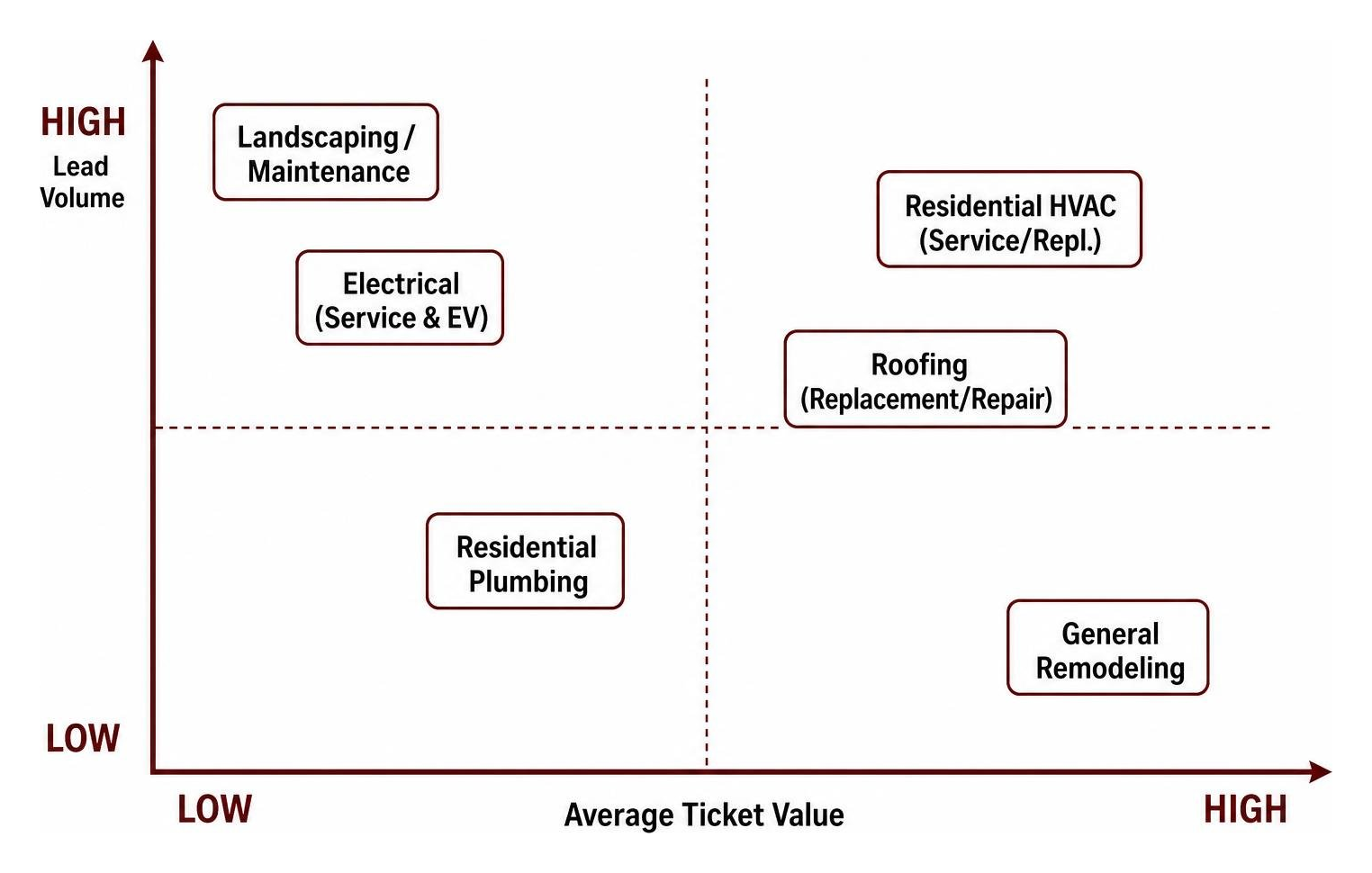
Acquisition costs and sustainable spending limits vary significantly depending on job ticket sizes, consumer urgency, and bidding workflows. Rather than treating third-party averages as universal truths, use these illustrative models to see how economics typically interact across different trade profiles:
| Trade Profile (Illustrative) | Example Search CPL Range | Example Close Rate Range | Illustrative Blended CAC | Example Job Ticket Range | Target CAC Margin Guideline |
|---|---|---|---|---|---|
| Residential Plumbing (Service) | $45 – $130 | 18% – 32% | $180 – $320 | $600 – $1,800 | 10% – 15% |
| Residential HVAC (Service/Repl.) | $55 – $140 | 15% – 28% | $250 – $350 | $4,500 – $12,000 | 8% – 12% |
| Roofing (Replacement/Repair) | $65 – $180 | 10% – 20% | $400 – $900 | $8,000 – $16,000 | 6% – 10% |
| Electrical (Service & EV) | $35 – $85 | 20% – 35% | $140 – $260 | $500 – $2,500 | 10% – 14% |
| Landscaping / Maintenance | $15 – $40 | 25% – 40% | $60 – $150 | $1,500 – $3,500 (Ann.) | 5% – 10% |
| General Remodeling | $75 – $220 | 6% – 14% | $800 – $2,200 | $15,000 – $85,000+ | 3% – 6% |
Note: These figures represent illustrative planning models rather than empirical industry standards. Actual acquisition costs fluctuate substantially based on local market saturation, intake speed, brand reputation, pricing models, and seasonal swings.
Understanding Acquisition Dynamics Across Trades
Comparing CAC figures between trades requires looking at how customers buy different types of services:
- Emergency vs. Consultative Purchases: Urgent service calls for plumbing and electrical work benefit from immediate intent. When a water heater bursts or a circuit fails, homeowners prioritize quick response times over gathering four different bids, generally resulting in higher close rates.
- Capital Replacements: HVAC system changeouts and complete roof replacements involve significant investments. Homeowners commonly collect multiple estimates, leading to longer decision cycles and higher lead costs, though higher job tickets maintain overall job profitability.
- Recurring Route Density: Maintenance services such as lawn care and pest control have lower initial ticket prices. However, a modest acquisition cost is quickly recovered across months of recurring contract revenue.
- High-Ticket Remodeling: General contractors and custom remodelers experience lower close rates on digital inquiries because prospective clients compare multiple proposals over several weeks. A higher acquisition cost remains sustainable given the large project revenue.
Seasonal Cycles and Demand Swings
Acquisition costs naturally fluctuate throughout the year:
- Extreme Weather Surges: During summer heatwaves or winter freezes, emergency HVAC repair searches surge. While ad auctions become more competitive, heightened consumer urgency often improves closing rates for teams that answer calls promptly.
- Storm-Driven Demand: Major hail and wind storms create sharp increases in roofing and exterior repair inquiries. Contractors with established local visibility can capture high-intent demand before ad costs spike.
- Shoulder-Season Lulls: In milder spring and autumn months, inbound emergency repair demand cools. Relying solely on paid search during these windows can drive up acquisition costs as search volume drops, making proactive outreach to past customers essential.
Channel Economics: Paid Ads, Local Search, and Referral Systems
Customer acquisition costs vary widely depending on the lead source and how inquiries are handled.
Paid Digital Channels: Google LSA, Search Ads, and Social Platforms
- Google Local Services Ads (LSA): Operating on a pay-per-call or pay-per-lead model with the Google Guaranteed badge, LSAs provide direct phone calls from local homeowners actively searching for service.
- Google Search (PPC): Traditional keyword search ads offer reliable volume and scalability, though cost per acquisition rises significantly in competitive service markets if landing pages fail to convert visitors into callers. Implementing a focused paid digital advertisement plan helps keep search ad budgets focused on high-intent terms.
- Paid Social (Meta Ads): Social ads work best for visual and discretionary trades such as custom remodeling, landscaping, or outdoor living. For emergency repairs, social platforms typically yield lower close rates because users are browsing content rather than actively seeking an urgent repair.
Organic Channels: Local Search, Reviews, and Referrals
- Google Business Profile & Local Search: A well-optimized profile ranking in the local map pack provides steady inbound phone calls without per-click fees. While building local map rankings takes consistent effort, developing long-term local SEO helps lower your overall blended acquisition cost across the business.
- Customer Referrals: Direct referrals from satisfied homeowners remain one of the most cost-effective acquisition paths, consistently producing high close rates and loyal customer relationships.
- Third-Party Lead Aggregators: Shared lead networks often look inexpensive on a per-lead basis. However, because multiple competing contractors are sent the same homeowner request simultaneously, close rates are frequently low, which can drive the final cost per booked job higher than expected.
Strategic Budget Allocation and Lifetime Value Considerations
Managing acquisition costs effectively requires balancing immediate job booking needs with long-term profitability.
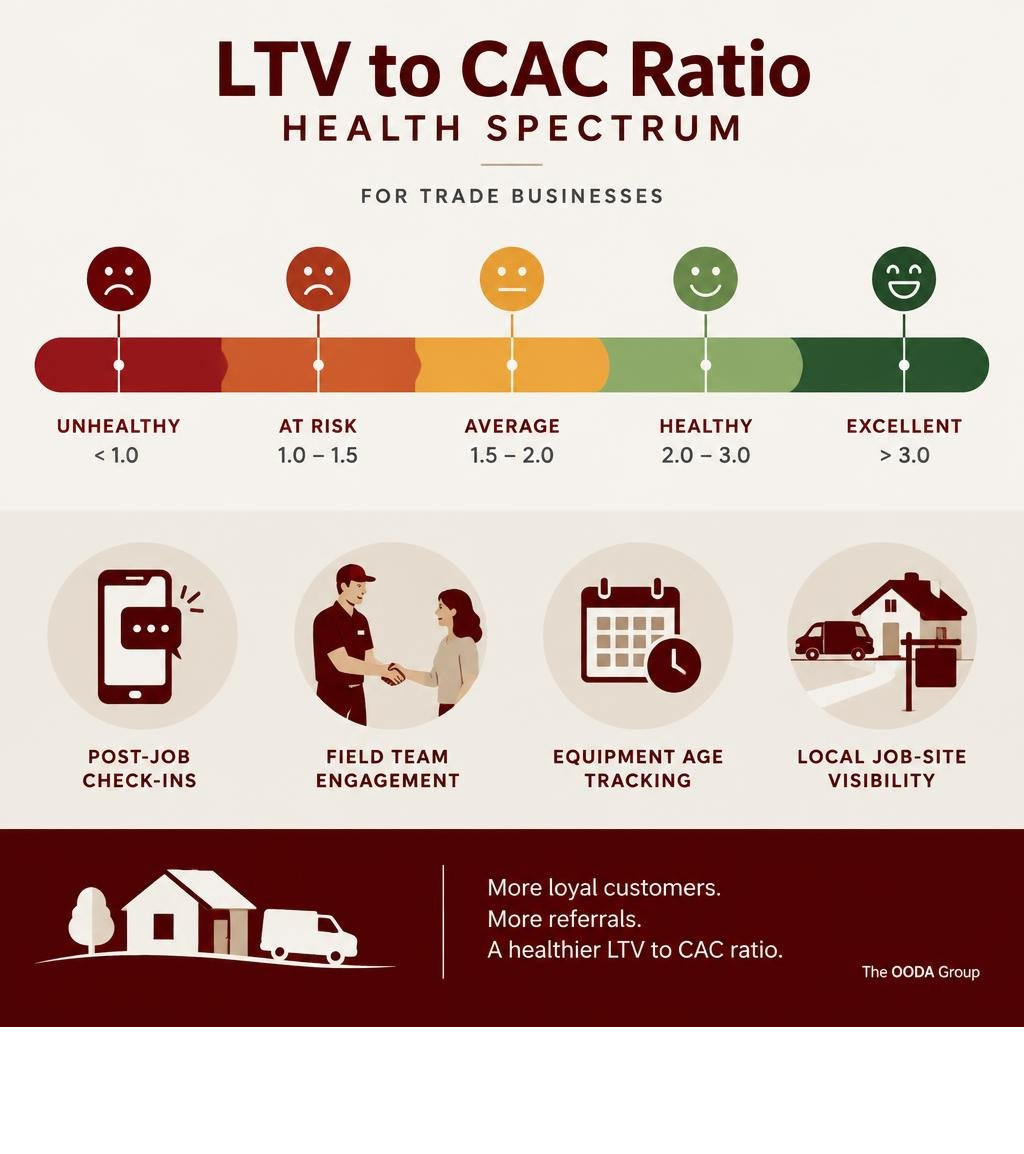
While a 3:1 to 5:1 LTV:CAC ratio is frequently cited as a general business benchmark, there is no universal target for every trade business. The right ratio depends entirely on your gross margins, fixed overhead, and customer retention. A high-ticket replacement contractor might operate comfortably with a 3:1 ratio due to massive upfront gross profit, whereas a service and maintenance business with ongoing overhead may need a higher ratio from repeat service agreements to remain soundly profitable.
To keep your pipeline healthy across changing seasons, consider balancing your budget across complementary channels:
- High-Intent Paid Channels: Direct search ads and Local Services Ads maintain immediate call volume when crews need near-term work.
- Local Search and Organic Visibility: Profile optimization and a strong digital presence build steady local discovery without recurring per-click fees.
- Customer Retention and Referral Systems: Automated follow-ups and service reminders generate profitable repeat business from your existing customer database.
- Brand Awareness and Local Visibility: Job-site signage and wrapped vehicles build familiarity within your primary service area.
Building Practical Referral and Retention Routines
Systematizing follow-up processes helps lower your overall acquisition costs over time.
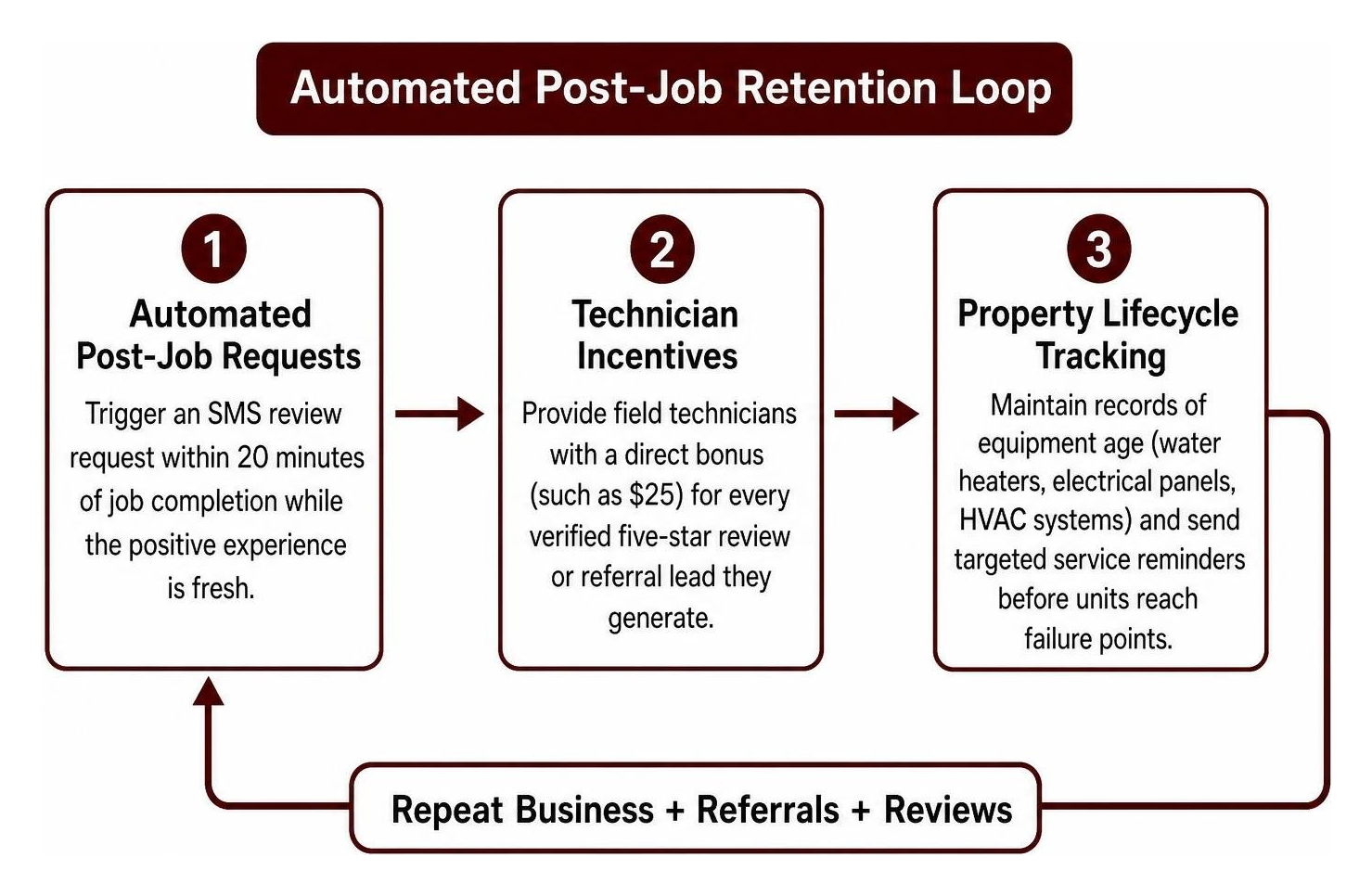
Effective service contractors use straightforward routines to keep past customers engaged:
- Prompt Post-Job Check-ins: Send an automated text message or email requesting feedback shortly after service completion while the positive experience is top of mind.
- Field Team Engagement: Encourage technicians and estimators to provide excellent on-site service and remind satisfied homeowners that the company welcomes referrals.
- Equipment Age Tracking: Keep organized records of major equipment installations and schedule proactive maintenance reminders before systems run into breakdowns.
- Local Job-Site Visibility: Clean vehicle signage and neatly placed yard signs turn active job sites into local neighborhood awareness.
Rebalancing Your Channel Mix
Combining organic local visibility with targeted paid advertising generally produces a more resilient pipeline than relying on a single lead platform.
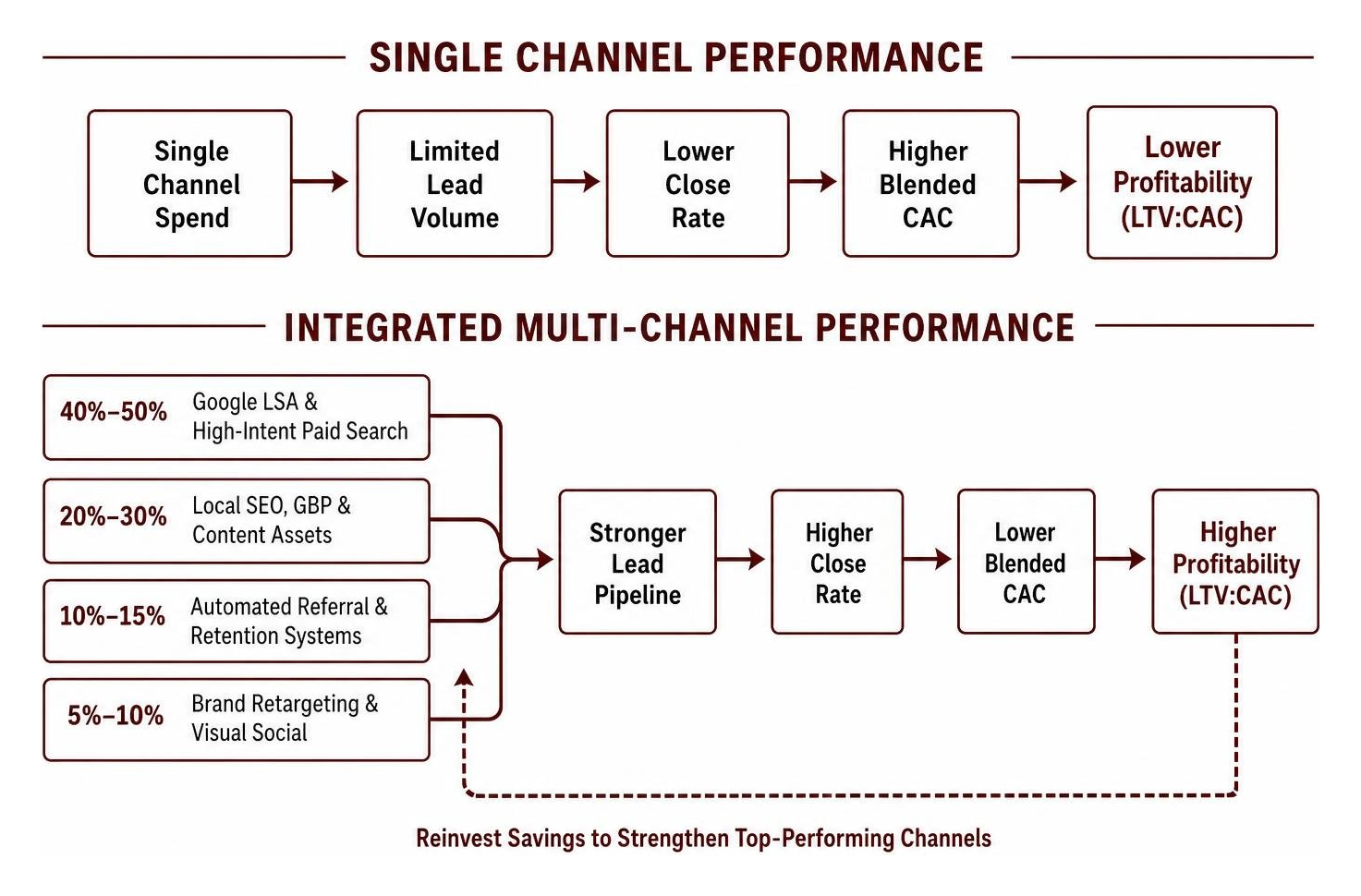
If your current acquisition costs are eating into your margins, take these practical steps to rebalance your spend:
- Review Shared-Lead Portals: Calculate the real cost per closed job on aggregator platforms and scale back spend on sources with low conversion rates.
- Prioritize Direct Search Channels: Ensure high-intent local search platforms and Local Services Ads are funded before testing broader advertising avenues.
- Track Revenue by Lead Source: Evaluate marketing performance by completed job revenue and gross profit rather than raw inquiry volume.
Frequently Asked Questions About Contractor Acquisition
What is considered a healthy LTV:CAC ratio for trade businesses?
There is no single universal standard. While many operators aim for a ratio around 4:1, the right threshold depends on your net margins, overhead structure, and service frequency. If an average customer generates $2,000 in gross profit across their lifetime, an acquisition cost of $400 to $500 is often sustainable, but businesses with higher fixed overhead or one-off transactional models will need to calculate their specific unit margins.
Why are lead aggregators often more expensive than direct search platforms?
Shared lead aggregators routinely sell the same homeowner inquiry to multiple contractors at once. This creates an immediate price-shopping environment that lowers average close rates. Exclusive direct search channels connect homeowners directly to your business, yielding higher close rates and often a lower true cost per booked customer.
How should contractors factor sales and office labor into CAC calculations?
For dedicated sales representatives or estimators whose primary job is quoting and closing new projects, include their wages and commissions in your acquisition expenses. For office dispatchers or intake staff, include the estimated share of their working hours spent answering new prospect calls and scheduling first-time estimates.
Managing Acquisition Costs for Long-Term Profitability
Managing your customer acquisition cost comes down to knowing your true numbers and allocating your budget where it produces profitable work.
A full dispatch board does not guarantee a healthy business if low closing rates and expensive lead sources erode your margins. Treat your marketing investments with the same discipline you apply to equipment, labor, and materials. Measure your cost per booked job accurately, invest in channels and customer relationships you control, and reallocate budget away from sources that fail to produce dependable returns.
Building an effective contractor construction marketing approach starts with clear tracking and steady operational execution. Focus on response speed, consistent lead qualification, and customer retention, and your acquisition numbers will reflect a stronger, more sustainable operation.