
The Zero-Click Shift: How to Show Up in Google AI Overviews as a Contractor
If you want your contracting business to have a fair shot at being cited in Google AI Overviews, stop treating your website like a digital brochure from 2012. An AI Overview is Google’s generated answer box at the top of some search results. The practical play is simpler than the hype: give clear answers to real customer questions, organize pages logically, build useful pages around your core services, and keep your business details consistent online. That gives Google clean, factual information to consider when a homeowner asks what a project costs or how a repair works.
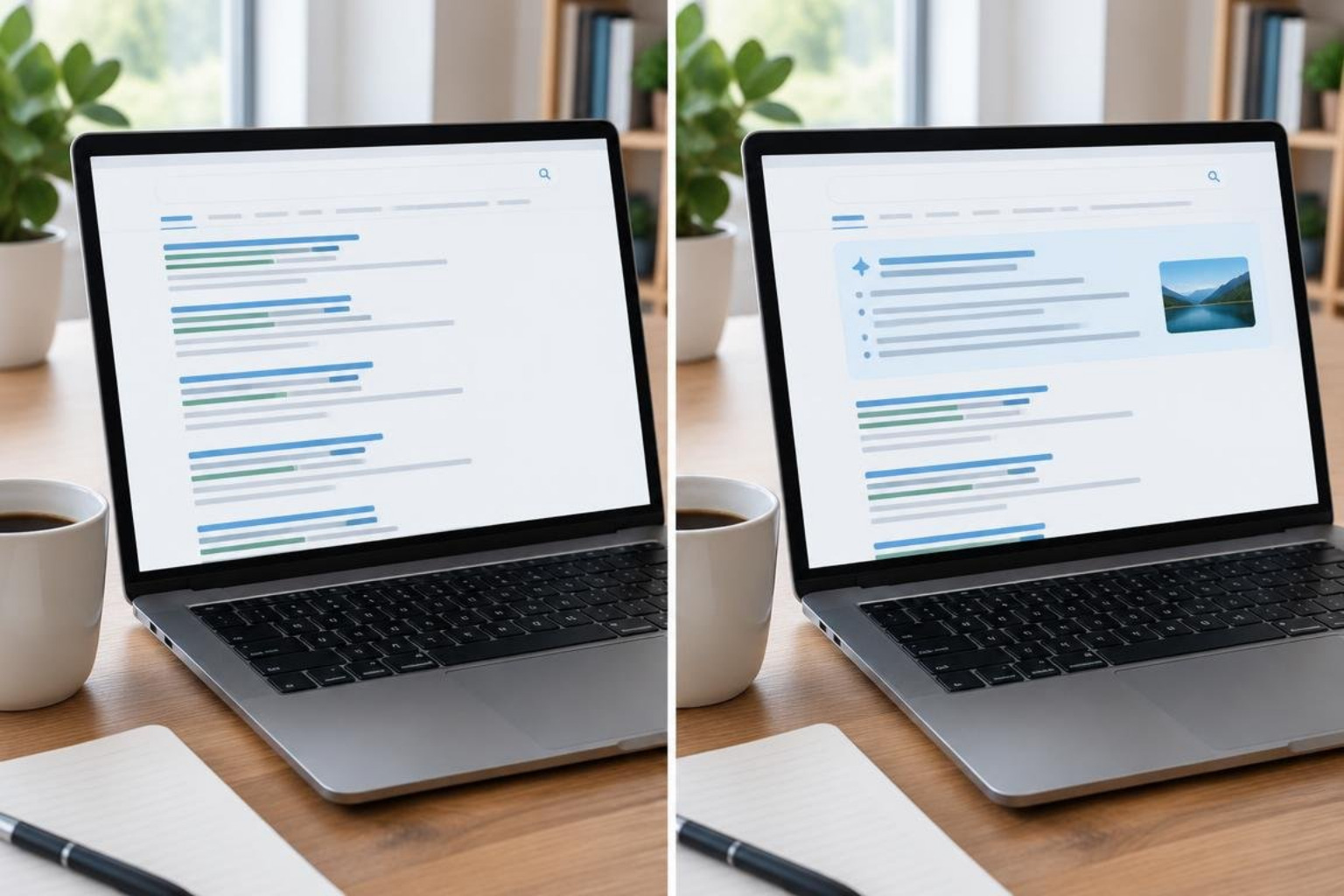
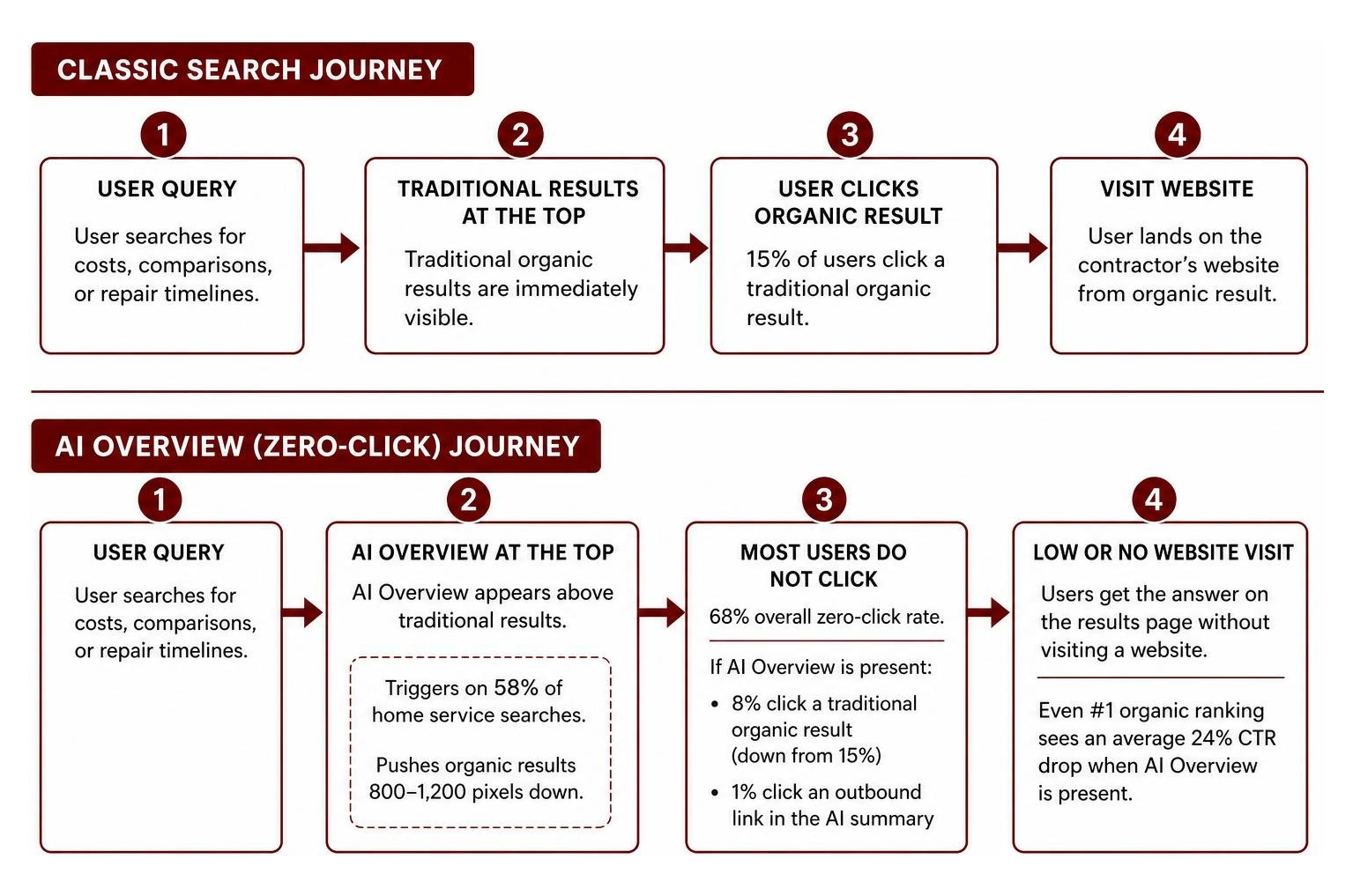
Search behavior continues to evolve. When homeowners look up repair costs, equipment comparisons, or project timelines for HVAC, electrical, plumbing, or roofing, Google sometimes generates an AI summary directly on the results page.
That summary can push the usual unpaid website listings farther down the screen. Even if your company appears near the top of a results page, you may see fewer clicks because the homeowner got a quick answer immediately. Being cited in an AI Overview will not magically fill your dispatch board with calls, but it can put your name in front of a homeowner while they are weighing options.
Google does not reward vague marketing slogans just because they have a lot of exclamation points. It needs pages that answer specific questions plainly, share realistic numbers, and make clear who is doing the work.
Why AI Overviews Matter to Your Bottom Line
When a homeowner searches for something like “average cost to replace a 50-gallon water heater” or “signs of a bad electrical panel,” they want a realistic estimate and a straightforward explanation. If Google summarizes that answer and cites your business as the source, you earn credibility before the homeowner even picks up the phone.
The best way to get found is not to chase every shiny search tactic. Make your site genuinely useful when a homeowner is trying to solve a real problem: clear answers, specific service information, realistic cost context, and proof that you know the work. Strong SEO (Search Engine Optimization), the practice of optimizing your website’s content and structure so search engines like Google can easily discover, understand, and rank your pages, turns those basics into a site that earns attention because it actually helps, not because it is shouting the loudest.
How Google Chooses Contractor Sources
Google reads and stores ordinary public web pages in its search index, the catalog it uses to decide which pages may appear in results. When a user asks, “How much does a 200-amp panel upgrade cost in Dallas?”, Google looks for useful pages covering cost ranges, local code considerations, and labor expectations.
If an electrical contractor’s page hides pricing behind four paragraphs of generic sales copy, Google has little concrete information to work with. A page that gives realistic ranges and explains the trade details in plain English is simply more useful.
Making Your Pages Easy to Read and Use
To make it easier for Google and homeowners to understand your site, format the content clearly. A practical pattern is simple: use a descriptive heading that states the question, then answer it right away in the next paragraph.
You may hear people call the main page title an H1 and the major sections underneath it H2s. Those are just website heading labels: the H1 tells readers and Google what the page is mainly about, while H2s break the page into clear topics. Smaller subheadings are often called H3s. You do not need to talk like a web developer; you just need each heading to describe what the next section answers.

| Page Element | Clear Answer Passage | Fluffy Sales Pitch (Often Skipped) |
|---|---|---|
| H2 Heading | How much does an AC compressor replacement cost? | Affordable AC Services You Can Count On |
| First paragraph | A residential AC compressor replacement typically costs between $1,200 and $2,800, including parts and labor. Exact costs depend on regional labor rates, system size, and warranty status. | When your AC breaks down in summer heat, you need a team you can trust. We offer great prices and friendly technicians. Call today for a free estimate! |
| Supporting details | A clean list of local cost factors and a simple table comparing system sizes. | A stock photo of a smiling technician holding a wrench. |
| Core facts | Verified regional labor ranges, warranty terms, and local permit requirements. | Vague promises of “unbeatable quality” and “100% satisfaction.” |
Using Business Details and Question Markup
You may also hear the word schema. Schema is behind-the-scenes website code that labels information for search engines, much like labels on a well-organized parts bin. It does not guarantee that Google will use your page in an AI Overview, but it can help Google understand what your visible page says. Google’s structured-data documentation explains the basics.
- Local business markup: Add accurate business details to your homepage and location pages, including your official name, address, phone number, operating hours, license numbers, and service areas.
- Question-and-answer markup: If a service page includes real customer questions and answers, the behind-the-scenes labels should match the visible wording exactly.
- Step-by-step markup: Use this for safety-first troubleshooting guides, such as “How to safely reset a tripped main breaker,” where the page genuinely walks readers through ordered steps.
Organizing Service Pages Around the Work You Do
A single 400-word page titled “Plumbing Services” does not prove much beyond the fact that you own a keyboard. If you install and service water heaters, build connected pages that answer the related questions homeowners actually ask in your market.
When organizing your website, group your trade knowledge into clear topic groups:
- Main service page: Residential Water Heater Installation and Repair. Cover types, sizing, lifespan, repair-versus-replace decisions, and local code requirements.
- Supporting page 1: Tankless vs. Tank Water Heater Cost and Efficiency.
- Supporting page 2: Warning Signs Your Water Heater Is Failing.
- Supporting page 3: Gas vs. Electric Water Heater Installation Requirements.
- Supporting page 4: Step-by-Step Guide to Flushing a Sediment-Filled Tank.
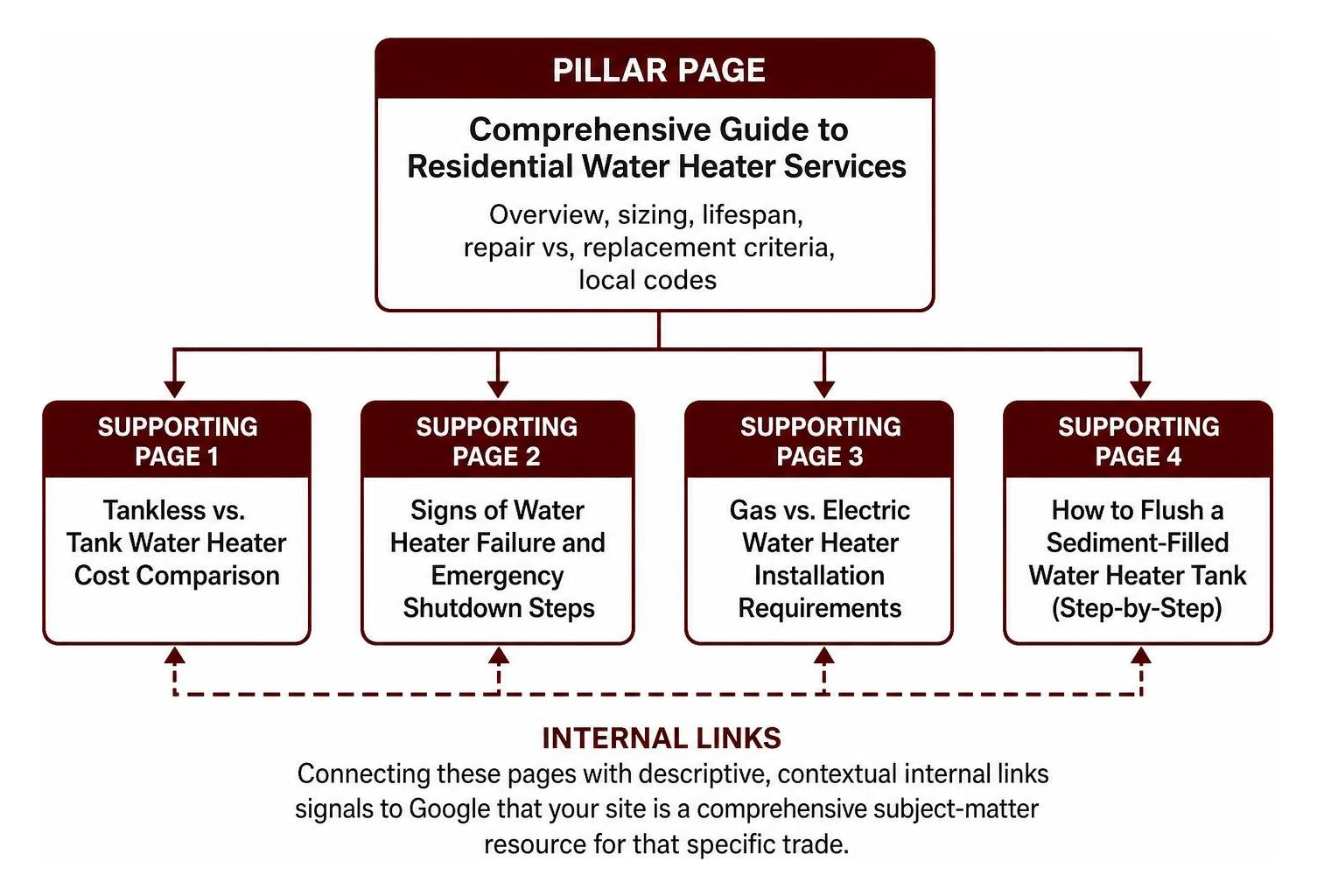
Linking these related pages to one another helps homeowners move from one useful answer to the next and helps Google understand the breadth of your trade knowledge.
Google Business Profile and Local Trust Signals
Your Google Business Profile, the business listing that can appear in Google Search and Maps, is a foundation of your local online presence. Keeping it accurate and aligned with your website helps Google connect the dots about who you are, where you work, and what you do.
Keep your profile updated and consistent:
- Primary and secondary categories: Choose the closest main category, such as “HVAC Contractor,” then add relevant additional categories, such as “Heating Contractor” or “Air Conditioning Repair Service.”
- Service menus: List the services you actually perform with brief explanations and, where it makes sense, typical starting prices instead of leaving the menu empty.
- Matching business details: Your business name, address, and phone number should match on your website, Google Business Profile, and major trade directories. Marketers sometimes call this NAP consistency, but it just means your contact information should not change from one listing to the next.
- Detailed customer reviews: Reviews that mention specific jobs and neighborhoods, for example “Replaced our 50-gallon Rheem water heater in Plano on the same day,” give homeowners useful context about your real-world service area.
Pricing Transparency
Google may use pricing context when it summarizes cost-related questions, although the sources it cites vary by market and search. Contractors who hide every number behind a generic “Call for a quote” button give homeowners and Google no factual starting point.
To make your pages more useful:
- Provide realistic price ranges on major installation and replacement pages. For example: “Main electrical panel replacements in our area typically range from $1,800 to $4,000 depending on amperage, grounding, and panel location.” Always explain that local labor rates, permit fees, and existing wiring conditions can change the final quote.
- Explain what moves the number up or down: equipment capacity, permit fees, access, and material choices.
- Use simple, readable tables on pricing pages rather than forcing every estimate behind a contact form.
Demonstrating Real Field Experience
Homeowners want proof that you know your craft before inviting your crew into their home. Fair enough.
- Show licenses and certifications: Include state or municipal license numbers, EPA certifications, NATE badges, and safety credentials on appropriate pages. Licensing rules differ by location, so be precise about what applies to your business.
- Use real author bios: Credit diagnostic and maintenance guides to actual master technicians or field supervisors, and describe their real background in the trade.
- Use real job photos: Post genuine photos of branded trucks, crews on job sites, and completed installations instead of leaning entirely on generic stock images.
A Practical Action Plan for Contractors
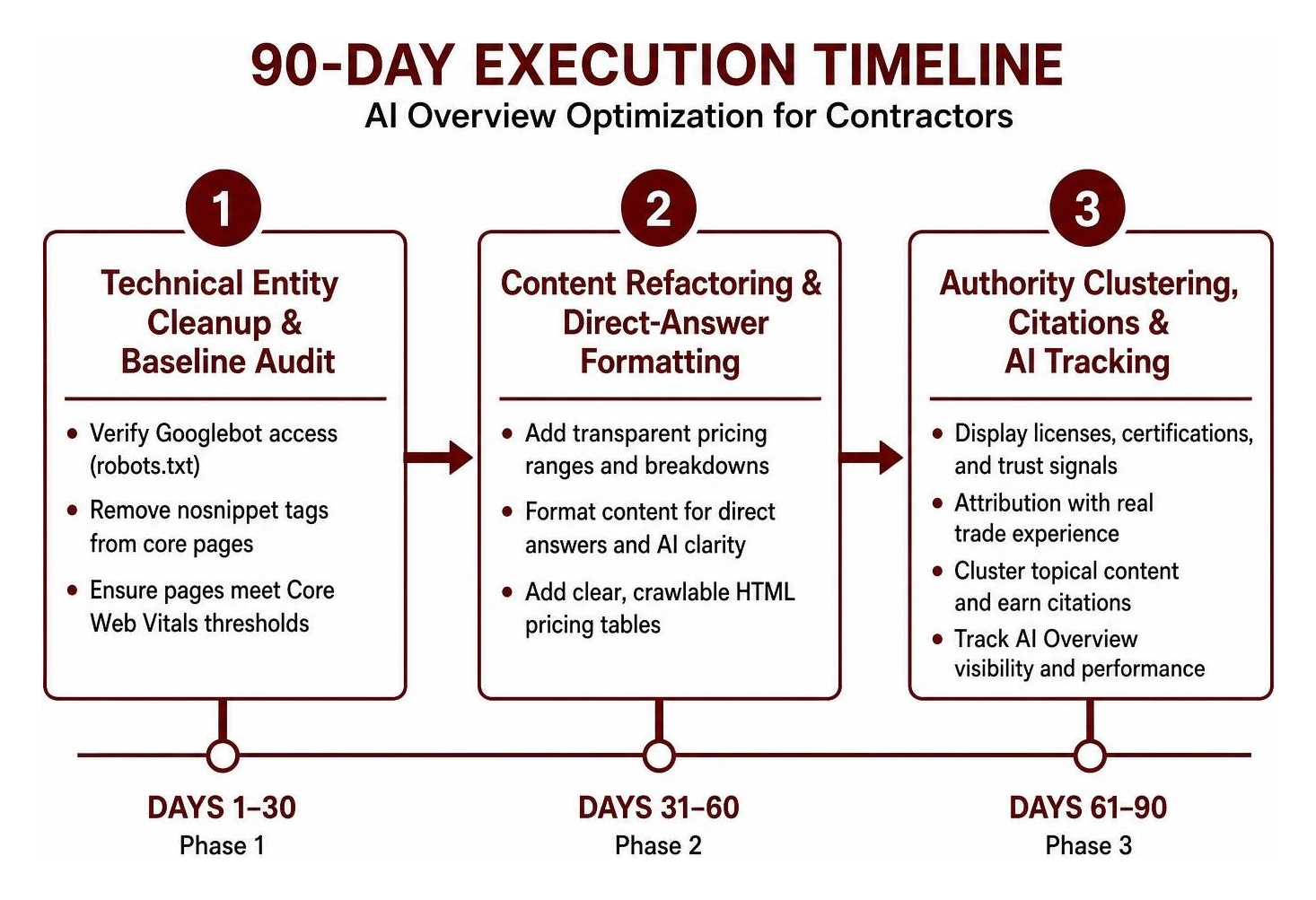
Making your website easier for Google and homeowners to evaluate does not require a complete rebuild. It requires direct answers, transparent pricing, and consistent business information.
Working these changes into your broader marketing plan helps ensure your website supports real job bookings rather than vanity metrics that look nice in a monthly report and do absolutely nothing for the schedule.
Priority Action Checklist
- Make sure Google can access your site: Check that your
robots.txtfile, a small instruction file that tells search crawlers which pages they may access, is not blocking important pages. Also make sure pages work smoothly on phones. - Rewrite key service pages: Identify the services that drive revenue and add question-based headings followed by clear, direct answers.
- Add accurate page labels in the code: Use the appropriate business and question-and-answer markup where it genuinely matches the visible page content.
- Provide realistic price ranges: Give homeowners honest ballpark figures and explain the labor, permit, and equipment variables specific to your service area.
- Update your Google Business Profile: Complete service descriptions, add pricing guidance where appropriate, and encourage satisfied customers to mention the work performed.
Common Mistakes Contractors Make
- Burying the lead: Writing paragraphs of company history before answering basic questions about pricing, diagnostic procedures, or project timelines.
- Vague marketing slogans: Relying on empty phrases like “quality service at affordable rates” instead of specific system details, warranties, and numbers.
- Mismatched page labels: Adding behind-the-scenes labels that contradict the words a homeowner can actually read on the page.
- Blocking useful excerpts: Accidentally adding a
nosnippetinstruction, which tells Google not to show text excerpts from a page in search results.
How to Track Results
Because Google may answer questions directly on the results page, website visits tell only part of the story:
- Google Search Console: This is Google’s free reporting tool for website owners. Watch total times your pages appeared in search results and their average placement. If appearances grow for informational trade questions while placement stays steady, your content may be getting more visibility in search features.
- Manual search checks: Periodically search common questions in your market, such as “cost to replace sewer line in [City],” to see which sources Google highlights. Results can change by device and location, so treat this as a spot check, not a gospel tablet.
- Call tracking and lead questions: Ask incoming callers how they found your company to learn whether your guides helped during their early research.
Frequently Asked Questions About AI Overviews for Contractors
Do I need special files like llms.txt to appear in AI Overviews?
No. You do not need a special llms.txt file, a proposed file format some people discuss for giving AI systems website guidance, to be eligible for Google AI Overviews. Google can consider ordinary public pages that it is able to access and store in its search index. In plain English: make sure your pages load, work on mobile, and contain readable information.
How long does it take to see changes in AI search visibility?
There is no fixed timeline. Google revisits and updates pages on its own schedule. As you improve service pages with clearer answers, transparent pricing, and accurate page labels in the code, Google may pick up those revisions during later visits.
Why did my website traffic drop even though my ranking stayed the same?
When Google’s AI summary answers a searcher’s question on the results page, fewer people may need to click through to a website. That can reduce visits from broad informational searches. Still, having your business cited in that summary can keep your name in front of homeowners while they are deciding who to call.
How Contractors Can Earn More Visibility in Google AI Overviews
Search is moving beyond a simple list of blue links. For contractors, staying competitive means understanding how Google gathers information and presents it to local homeowners.
Improving visibility in AI summaries is not about gaming an algorithm. It is about running a clear, transparent website: answer customer questions plainly, share honest pricing ranges with local caveats, organize pages around the services you actually provide, and keep your business details accurate everywhere they appear.
To see how these practical website improvements fit into contractor marketing, review our service for helping businesses get found online. For more practical guidance on growth and operations for home service companies, browse our marketing blog.