
The Multi-Touch Reality: How Long Should Contractors Follow Up on Estimates?
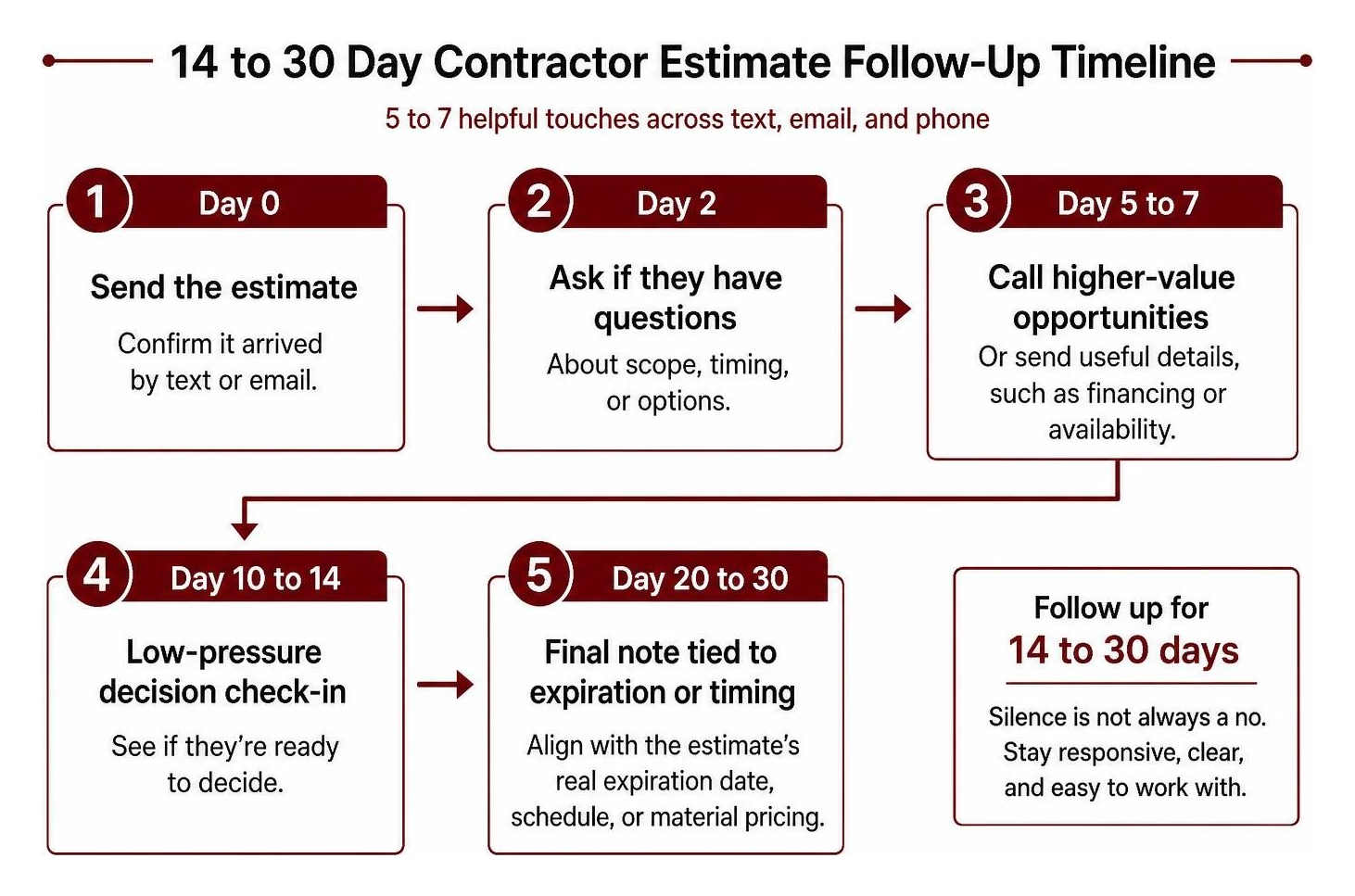
For most estimates, contractors should follow up for 14 to 30 days, using about five to seven helpful touches across text, email, and phone. Start with a delivery confirmation right away, make the first real follow-up within 24 to 48 hours, then space later messages several days apart.
A practical starting cadence:
- Day 0: Send the estimate and confirm it arrived by text or email.
- Day 2: Ask whether they have questions about scope, timing, or options.
- Day 5 to 7: Call higher-value opportunities or send useful details, such as financing or availability.
- Day 10 to 14: Make a low-pressure decision check-in.
- Day 20 to 30: Send a final note tied to the estimate’s real expiration date, schedule, or material pricing.
Silence is not always a no. Homeowners may be comparing bids, waiting on another decision-maker, or simply dealing with a busy week. But an estimate with no next step is not a sales process. It is an open loop.
The goal is not to chase people daily. It is to be responsive, clear, and easy to work with. Each message should offer a useful reason to reply and an easy way to say “not now.”
Between 30% and 50% of sent estimates never convert, and research shows that roughly 60% to 70% of quotes die from customer silence rather than an explicit rejection. A common pattern across trades is that 44% of salespeople stop after just one follow-up attempt, even though about 80% of sales require at least five touches to close. Companies using structured follow-up sequences routinely see close rates climb from 22% to 47%.
When evaluating how long should contractors follow up on estimates, the key is understanding that speed and steady multi-channel communication win jobs. Prospects contacted within 5 minutes become qualified opportunities 21 times more frequently than those reached after 30 minutes. Furthermore, first responders capture between 35% and 78% of all sales.
Structuring the 14-to-30-Day Contractor Estimate Follow-Up Sequence
A reliable estimate sequence prevents prospect fatigue by spacing messages logically. Each touchpoint must provide distinct value, such as clarifying project staging, reviewing material lead times, or providing budget flexibility.
According to multi-channel follow-up data, using both email and text makes your outreach 2.4 times more effective than relying on a single channel. Clear stop conditions must be built into your process: pause all automated reminders the moment a homeowner responds, requests a change, accepts the bid, or declines.
Days 0 to 2: Establishing Contact and Confirming Proposal Receipt
The first 48 hours set the standard for your communication. As soon as the proposal is sent, deliver an immediate confirmation text message. Link-based digital estimates close 32% more often than static PDF attachments because they allow you to verify delivery and see when a customer reviews the scope.
Within 24 to 48 hours, send a simple follow-up to address initial impressions. Prompt first follow-ups boost overall reply rates by up to 49%. Confirm that the scope matches what was discussed on-site and offer to adjust specific line items.
Days 3 to 7: Addressing Project Scope, Financing, and Lead Times
By days 3 to 7, homeowners are typically comparing competing bids or evaluating their financing. Rather than sending a generic reminder, introduce practical solutions that remove friction.
Offering financing increases contractor close rates by 30% and average project sizes by 40%, with 87% of trade businesses noting that flexible payment options directly helped win jobs. Use this window to explain equipment availability, manufacturer lead times, or seasonal schedule openings.
Days 8 to 14: Overcoming Decision Paralysis and Framing Availability
During the second week, homeowners often stall due to decision fatigue or competing family priorities. A professional check-in helps guide them forward without pressure.
Highlight upcoming production schedules and crew allocations for their neighborhood. A structured construction estimate cadence focuses on practical project logistics, giving the client a genuine operational reason to make a decision.
Days 15 to 30: Quote Expiry Deadlines and Graceful File Closures
In the final phase, reference your estimate validity period. Most contractors set a 30-day expiration window to protect against supplier price adjustments and labor rate shifts.
Around day 20 to 30, send a respectful file-closure message. Inform the client that you are updating your production calendar and closing their active estimate file, while making it easy for them to reopen the project whenever they are ready.
Channel Strategy and Communication Scripts Across the Follow-Up Cadence
A balanced communication mix prevents your business from feeling intrusive. Combining text messaging for high-priority alerts, email for detailed documentation, and phone calls for personal relationship-building creates a professional workflow. Integrating this cadence into your broader marketing strategy ensures that customer acquisition investments turn into closed contracts.
Determining How Long Should Contractors Follow Up on Estimates by Project Size
The timeline and frequency of your follow-ups should reflect the financial commitment and complexity of the project.
| Project Type | Scope & Price Range | Follow-Up Window | Recommended Cadence | Primary Channels |
|---|---|---|---|---|
| Service Calls & Small Repairs | Under $1,000 (e.g., panel swap, leak repair, minor HVAC fix) | 3 to 7 Days | Day 0 (send), Day 1 (text), Day 3 (call/text closure) | SMS & Phone |
| Mid-Size Installations | $1,000 to $10,000 (e.g., water heater, partial re-roof, system replacement) | 10 to 14 Days | Day 0, Day 2, Day 5, Day 9, Day 14 | SMS, Email & Phone |
| Major Remodels & Construction | $10,000+ (e.g., custom additions, full renovations, major commercial) | 21 to 30+ Days | Day 0, Day 3, Day 7, Day 12, Day 20, Day 30 | Email, Phone & On-site Walkthroughs |
Multi-Channel Mix: Text Messaging, Email Updates, and Strategic Phone Calls
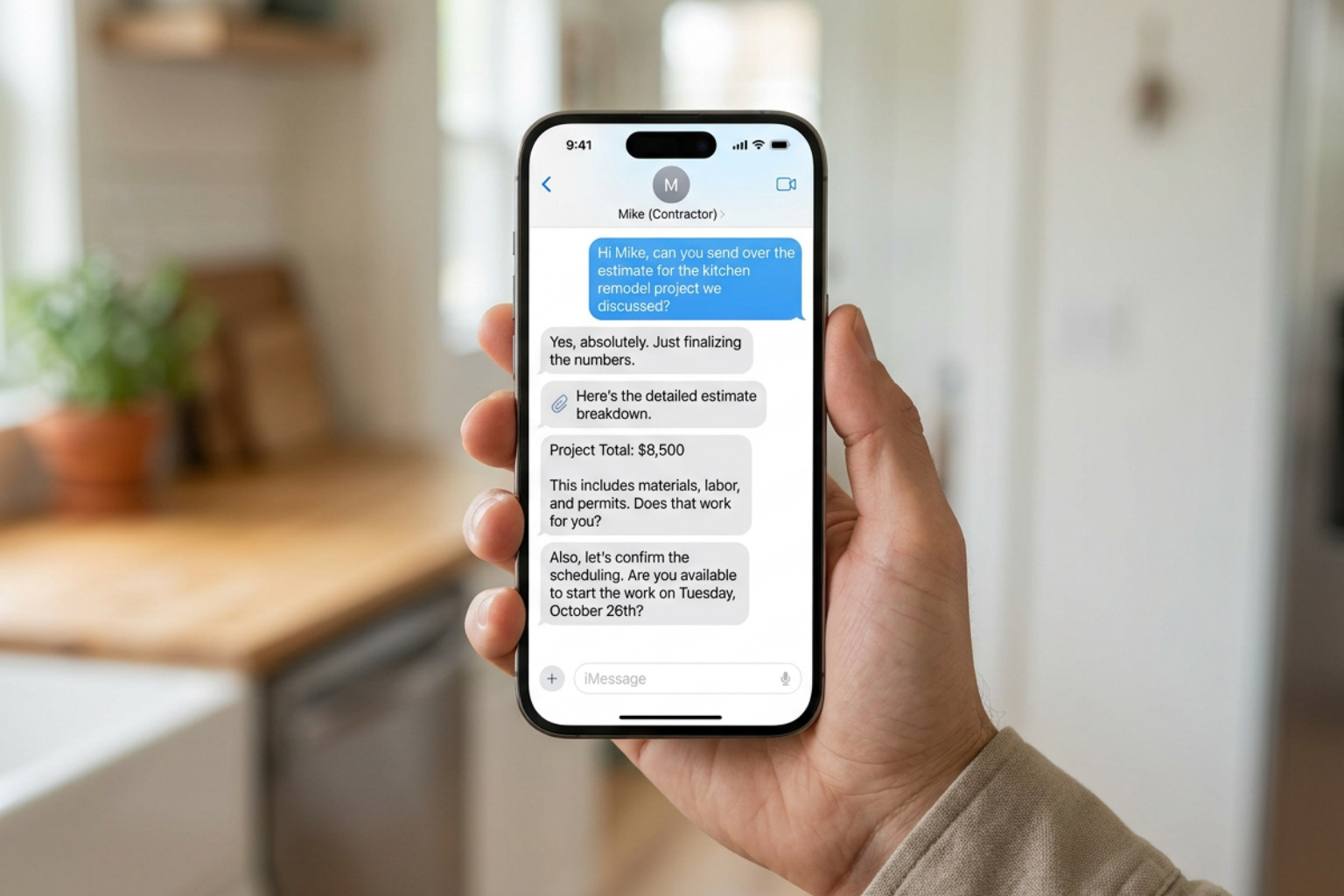
Text messaging delivers response rates between 60% and 90%, making it ideal for quick acknowledgments and scheduling questions. Email provides context, specification sheets, and digital signature links. Phone calls add a personal touch for projects over $5,000.
Varying your channels across touchpoints reduces communication fatigue and allows homeowners to engage using their preferred method.
High-Converting Scripts for Quotes Without Sounding Pushy
Day 0: Delivery Confirmation (SMS)
“Hi [Customer Name], this is [Your Name] with [Company]. I just emailed your detailed estimate for the [Project Type]. You can review and approve it directly through this link: [Link]. Let me know if you have any trouble opening it!”
Day 2: Scope Review (Email)
Subject: Quick question regarding your [Project Type] quote
“Hi [Customer Name],
I wanted to confirm you had a chance to look over the estimate for your [Project Type].
When reviewing the line items, did the scope match everything we discussed during the site visit? If you want to adjust any materials or phases, I am happy to update the details.
Best regards,
[Your Name]
[Company Name]”
Day 5: Value & Financing Check-in (SMS or Phone Voicemail)
“Hi [Customer Name], [Your Name] from [Company]. We are finalizing our installation schedule for next month. We also offer monthly payment plans starting at [Dollar Amount]/month if that helps with budgeting. Let me know if you would like me to send those options over.”
Day 14: Graceful File Closure (Email)
Subject: Closing your file for [Project Type]
“Hi [Customer Name],
We haven’t heard back regarding the estimate for your [Project Type], so I assume the timing is not quite right or you decided to go in a different direction.
I am going to archive this quote to keep our production calendar accurate. If you decide to move forward down the road, simply reach out and we will update the material pricing for you.
Thanks again for the opportunity to look at the project.
Best,
[Your Name]
[Company Name]”
Pipeline Hygiene: When to Step Back and Move Leads to Cold Reactivation
A cluttered sales pipeline distorts your revenue forecasting. When contractors avoid closing out cold files, their sales teams waste hours chasing dead leads instead of focusing on active buyers. In an extensive analysis of quote abandonment, maintaining clear pipeline stages was shown to directly improve lead conversion efficiency.
Evaluating How Long Should Contractors Follow Up on Estimates Before Archiving Leads
After five to seven unanswered touches across 14 to 21 days, active follow-up should end. Continuing to call or text every few days damages your brand reputation and yields diminishing returns. Transition unresponsive leads out of your active dispatch queue and into an archived stage in your CRM.
The 60-to-90-Day Seasonal Reactivation Framework
Archiving a lead does not mean deleting it permanently. Homeowners frequently shelve home improvement projects due to unexpected life events or temporary cash flow limits.
Every 60 to 90 days, run a simple, low-pressure reactivation campaign across older unclosed estimates. Reaching out during seasonal schedule openings or before annual manufacturer price updates can reactivate dormant prospects. Using structured, data-driven systems helps companies book more jobs from leads they have already paid to acquire.
Frequently Asked Questions About Contractor Estimate Timelines
How soon after sending an estimate should a contractor make the first follow-up?
Send an immediate delivery confirmation via text or email on Day 0. The first substantive follow-up should occur within 24 to 48 hours to confirm that the customer reviewed the specifications and to answer any initial scope questions.
How many total follow-up attempts should contractors make before stopping?
Most residential and commercial trade contractors should make five to seven total touches over a 14- to 30-day period. This sequence should combine text messaging, email, and one or two phone calls before moving the prospect to a long-term reactivation list.
Does adding quote expiration dates make contractors look too aggressive?
No. Clear expiration dates (typically 30 days) protect your business margins against volatile material prices and labor rate adjustments. When explained transparently, valid date limits demonstrate operational maturity and create a natural reason to check in before pricing updates.
Aligning Lead Generation with Disciplined Sales Execution
A reliable follow-up sequence is only as effective as the marketing and operational infrastructure supporting it. At The OODA Group, we operate as a managed marketing partner acting as the outsourced marketing department for established home-service and trade companies.
We apply the Observe, Orient, Decide, Act (OODA) framework alongside our Keep, Connect, Replace, or Retire operating methodology to eliminate wasted ad spend, connect sales data to marketing campaigns, and ensure high-intent leads turn into booked revenue. By combining full-funnel visibility with disciplined follow-up workflows, our marketing systems help business owners scale predictably without operational chaos.
If you are ready to evaluate your customer acquisition pipeline and eliminate revenue leakage, book an introductory consultation with our team.