
What to Do When Leads Do Not Answer
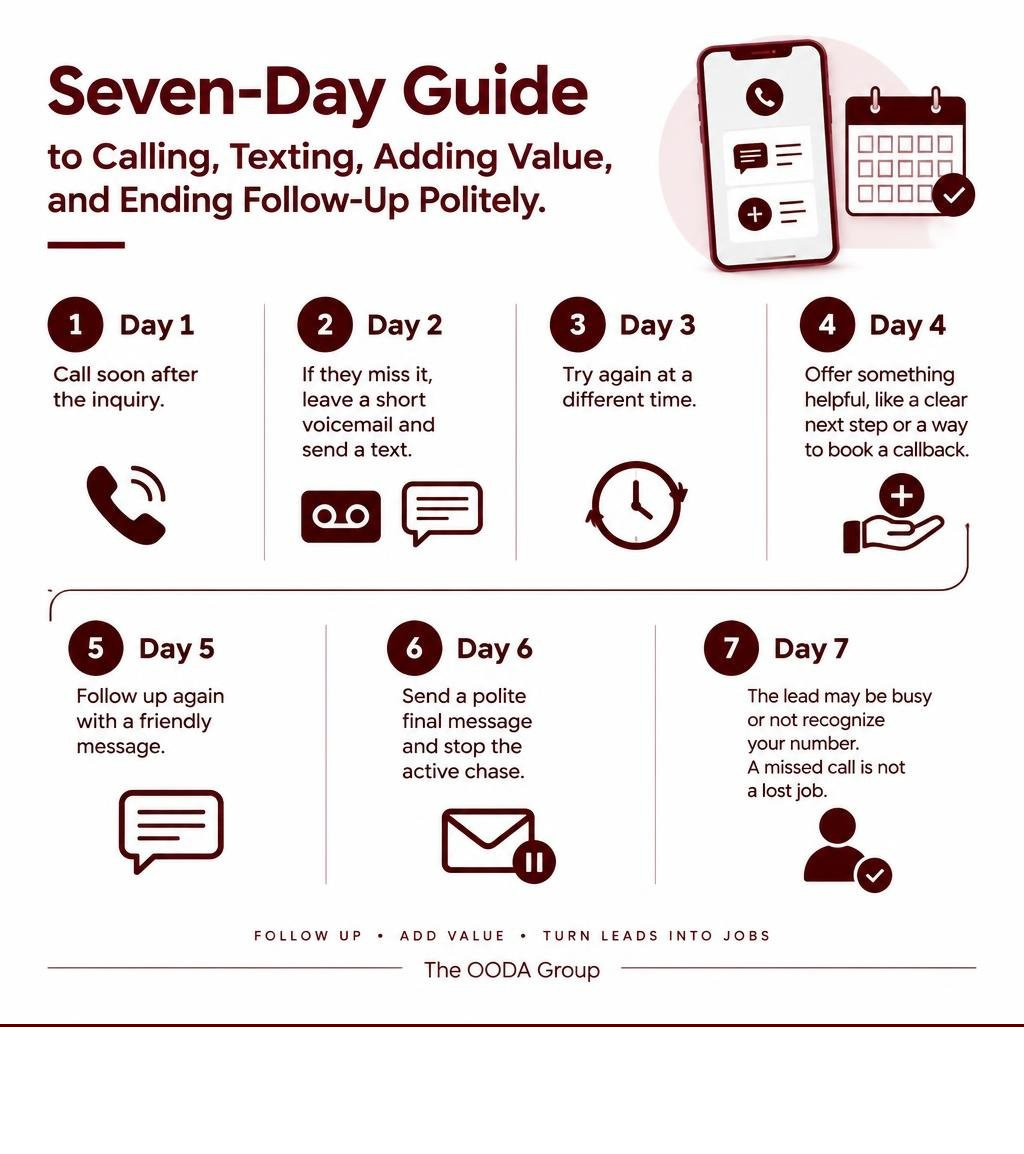
Knowing what to do with leads that do not answer starts with a fast, useful follow-up. Call soon after the inquiry. If they miss it, leave a short voicemail and send a text that names your business and the job they asked about. Try again at a different time, then offer something helpful, such as a clear next step or a way to book a callback. After several attempts, send a polite final message and stop the active chase.
A missed call is not a lost job. The lead may be busy or may not recognize your number. I’m Eric Turner, and I’ll show you how to follow up without becoming the caller they keep avoiding.
Basic what to do with leads that do not answer glossary:
What to Do With Leads That Do Not Answer: The Multi-Touch Recovery Engine
Every contractor knows the frustration: an inbound lead lands in your system, you dial their number within minutes, and it goes straight to voicemail.
Industry data shows that 62% of inbound leads do not answer the first outbound phone call. Even worse, roughly 87% of Americans ignore calls from unrecognized phone numbers entirely. When an owner stops dialing after one or two tries, customer acquisition cost spikes and healthy pipeline leaks away.
About 48% of contractors never follow up after a missed call, and another 32% give up after two attempts. Yet, an estimated 70% of lost leads go elsewhere simply because the contractor stopped reaching out, not because the homeowner chose someone else.
Systematic follow-up recovers an average of $8,400 per month in otherwise lost revenue for trade businesses. To capture this revenue, you must understand estimating your follow-up cadence across call, text, and email channels while respecting consumer communication standards.
Why Inbound Prospects Ghost (and How Caller ID and Speed Impact Pickup Rates)
When someone submits a form for a roof replacement, panel upgrade, or HVAC repair, silence rarely means rejection. Prospects ghost for predictable operational reasons:
- Carrier spam flags and missing caller ID: If your telecom provider does not register your exact business name on outbound caller ID, mobile carriers may label your call as “Spam Likely.”
- The three-second pause: Roughly 75% of people hang up when greeted by dead air at the start of a call. When a lead picks up, speak within the first three seconds.
- Comparison shopping: Homeowners often request three estimates at once. 78% of buyers hire whichever qualified business responds first.
- Inconvenient timing: The prospect filled out your form while on a break at work, but cannot take a personal voice call when you ring back ten minutes later.
Meeting contractor response time expectations means treating response speed as an operational system across every channel, not just a frantic phone call.
What to Do With Leads That Do Not Answer in the First 24 Hours
If your initial call goes unanswered, pivot immediately. Responding within five minutes gives you the best chance of securing a live conversation, but telephone outreach alone is no longer enough.
Text messages sent two minutes after a missed call generate a 45% response rate, compared to just 12% for a second cold phone call.
| Outreach Channel | Typical Response Rate | Average Reply Speed | Primary Buyer Advantage |
|---|---|---|---|
| Immediate Outbound Call | 38% pickup rate | Instant (if answered) | Establishes immediate personal connection |
| Post-Call SMS / Text | 45% reply rate | 11 minutes | Low friction, bypasses spam call filters |
| Second Phone Attempt | 12% pickup rate | 4.5 hours (voicemail callback) | Catches prospects at alternative daily hours |
| Follow-Up Email | 18% to 24% open/reply rate | 2 to 6 hours | Delivers structured quotes, licensing, and links |
Always include a direct link to a self-service calendar or callback scheduling link inside your missed-call text. When you allow a busy property owner to choose a specific ten-minute window, contact rates increase dramatically.
Multi-Channel Follow-Up Cadence: Balancing SMS, Voicemail, and Direct Outreach
Contractors who make five or more structured follow-up attempts close 32% more jobs than those who quit after one or two. The goal is to alternate communication channels over seven days without overwhelming the prospect.
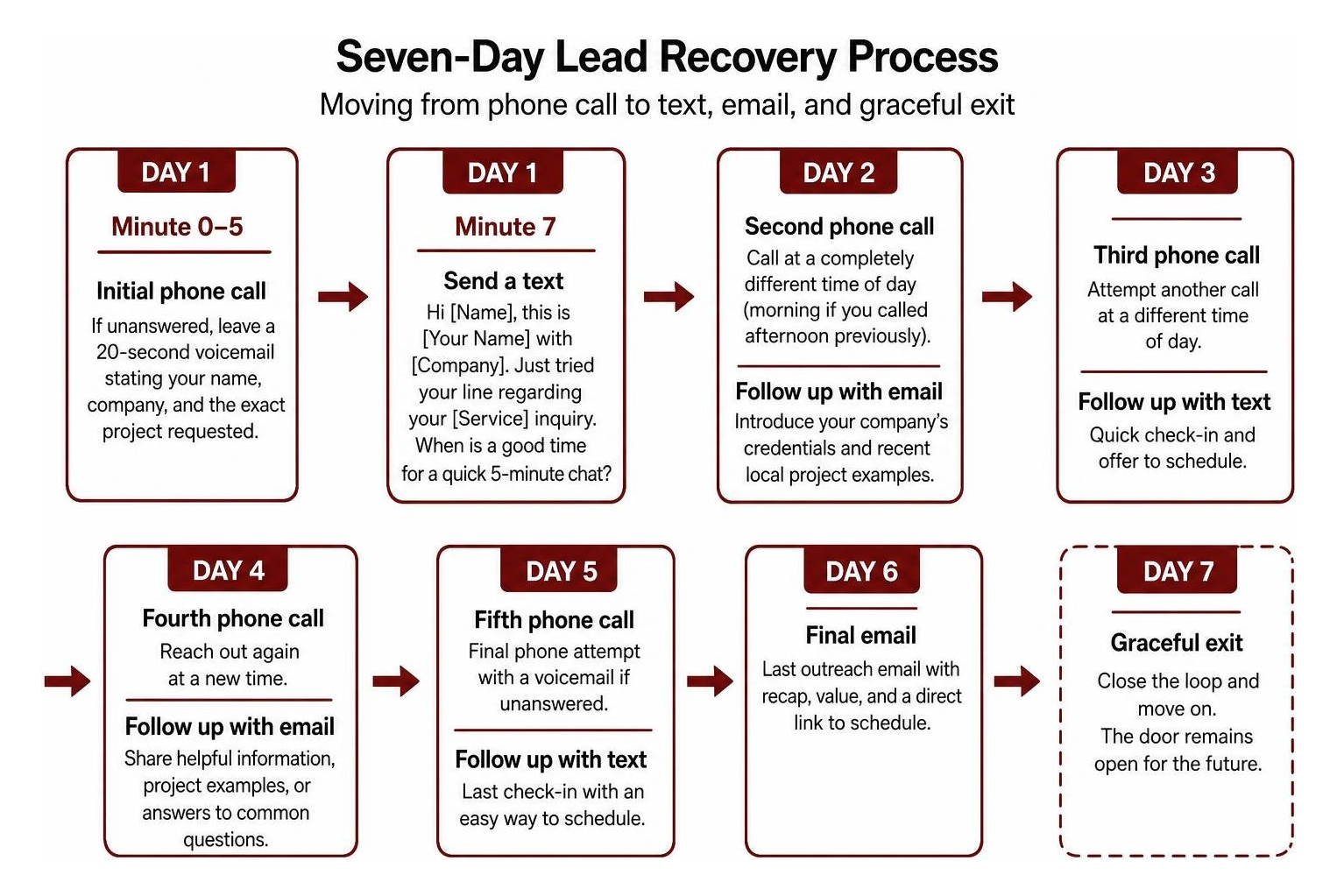
Here is the seven-day framework we recommend for active inbound inquiries:
- Day 1 (Minute 0 to 5): Initial phone call. If unanswered, leave a 20-second voicemail stating your name, company, and the exact project requested.
- Day 1 (Minute 7): Send a personalized text: “Hi [Name], this is [Your Name] with [Company]. Just tried your line regarding your [Service] inquiry. When is a good time for a quick 5-minute chat?”
- Day 2: Place a second phone call at a completely different time of day (morning if you called afternoon previously). Follow up with an email introducing your company’s credentials and recent local project examples.
- Day 3: Send a value-add text sharing a project pricing guide or addressing common project questions.
- Day 5: Deploy an email case study demonstrating a completed installation in their neighborhood, supported by automated contractor email nurturing workflows.
- Day 7: Send a direct, polite breakup message across SMS and email to close out active outreach.
Pattern-Interrupt Openers and Breakup Messages That Trigger Immediate Replies
When a prospect ignores standard outreach, generic phrases like “Just checking in” or “Touching base” ensure your message gets deleted. Use pattern-interrupt openers that present fresh angles:
- The Market Trigger: “Hi [Name], we just completed a panel upgrade on [Street Name] two blocks from you. Since our crew is in the neighborhood Thursday, I can waive our standard site visit fee if you still need that estimate.”
- The Risk Reframe: “Most homeowners we talk to are worried about surprise change orders on their remodel. Here is our fixed-price scope checklist so you know what to watch out for, even if you work with another contractor.”
If the prospect remains silent by Day 7, use a strategic breakup message. Breakup messages trigger psychological loss aversion and achieve a 22% reply rate.
“Hi [Name], since I haven’t heard back regarding your [Service] request, I assume your project priorities have shifted or you’ve already found another provider. I am closing out your inquiry so we don’t bother you with further messages. If you ever need help down the road, reach back out.”
Paired with targeted email lead nurturing, this graceful exit gives prospects permission to say “not right now” while leaving the door open for future work.
What to Do With Leads That Do Not Answer After 30 to 90 Days
When a lead stays silent past 30 days, they enter your dormant database. This list represents one of the highest-ROI assets in your business.
Roughly 40% of online service inquiries transact within 24 months of their initial form fill, and 35% of homeowners who do not reply in week one book a contractor within 90 days. Reactivating an existing contact costs five to ten times less than buying a brand-new lead.
Segment dormant leads using a simple triage matrix:
- Tier 1 (High Fit, Prior Conversation): Reached the proposal stage before going dark. Deliver personalized check-ins tied to seasonal adjustments or manufacturer equipment rebates.
- Tier 2 (High Fit, Form Fill Only): Never answered initial calls. Re-engage with quarterly educational newsletters, case studies, or service reminders.
- Tier 3 (Low Fit or Invalid Contact): Archive after 18 months of zero engagement to maintain clean email deliverability and avoid carrier spam flags.
A systematic reactivation campaign built around a solid comprehensive marketing strategy routinely revives 5% to 15% of a dormant CRM list without adding ad spend.
Stop Leaving Revenue on the Table: Build an Automated Lead Reactivation System
Unanswered leads are not dead ends; they are simply unorganized pipeline opportunities. When you replace sporadic callbacks with fast multi-channel cadences, clear caller ID configurations, and automated reactivation sequences, your marketing dollars produce far more booked jobs.
At The OODA Group, we build results-based marketing systems, advertising engines, and automated revenue pipelines for commercial and residential contractors. Whether you are generating inbound demand, managing modern lead capture, or reaching customers through emerging channels like advertising on ChatGPT, our fractional CMO and growth systems deliver measurable bookings without locking your business into rigid long-term contracts. Take a hard look at your dormant lead list today, put a structured recovery sequence in place, and turn your silent prospects into closed revenue.