

How to Choose an Outsourced Marketing Department for Contractors
An outsourced marketing department for contractors should give you more than a vendor list. It should manage the marketing work that supports your real operating goals: the right calls, qualified estimates, booked jobs, healthy margins, and work your team can actually handle.
Start by evaluating providers on five points:
- Strategy before marketing methods: Can they connect marketing activity to your service mix, service area, seasonality, capacity, and growth plan?
- Relevant skills: Do they have the capabilities you need now, such as helping local customers find you, paid advertising, turning website visits into calls or estimate requests, managing reviews, creating content, or tracking results, without selling every service by default?
- Clear ownership: Will one team coordinate the work, reporting, vendors, and priorities instead of leaving you to manage five specialists?
- Operational fit: Can they work with dispatch, sales, estimating, and your customer relationship management (CRM) system, which tracks prospects and customers, or your process for recording which marketing efforts generate calls?
- Measurable reporting: Do they report on whether inquiries fit your services, the share that become bookings, the cost to win a customer, potential jobs moving toward a sale, and revenue, not just clicks and the number of times an ad is shown?
For many established home-service and contracting companies, the better choice is not hiring a random freelancer for each task or signing up for a giant agency package. It is building a managed marketing function around the gaps that matter most, then adjusting as the business grows.
The OODA Group approaches that work as a managed marketing partner. Using the Observe, Orient, Decide, Act framework (reviewing the market, weighing options, choosing priorities, and putting the plan to work) and a Keep, Connect, Replace, or Retire review of your current efforts, the goal is to make marketing easier to manage and harder to waste.

Why Growing Trade Businesses Hand Off Marketing Management

Many established trade businesses reach a point where word-of-mouth or do-it-yourself marketing no longer brings in enough work to keep crews busy consistently. As your service area expands, vehicle costs climb, and payroll grows, guessing about where the next customer will come from gets risky.
When you start out, you may handle marketing yourself. As the business grows, you need a written plan, and your staff may not have the time or marketing skills to support growth on their own. Running a contracting firm already means getting jobs done, managing staff and inventory, and tracking job costs. Expecting an owner or office manager to also master how search engines rank local businesses, how to bid for ad placements, software that tracks marketing results, and turning website visits into inquiries is asking too much.
Hiring separate providers can leave you coordinating their work yourself. Hiring individual freelancers often turns the owner into an unpaid traffic cop who coordinates tasks rather than running the company. Conversely, hiring a dedicated in-house marketing team adds payroll, software, and management costs that you need to weigh against expected returns.
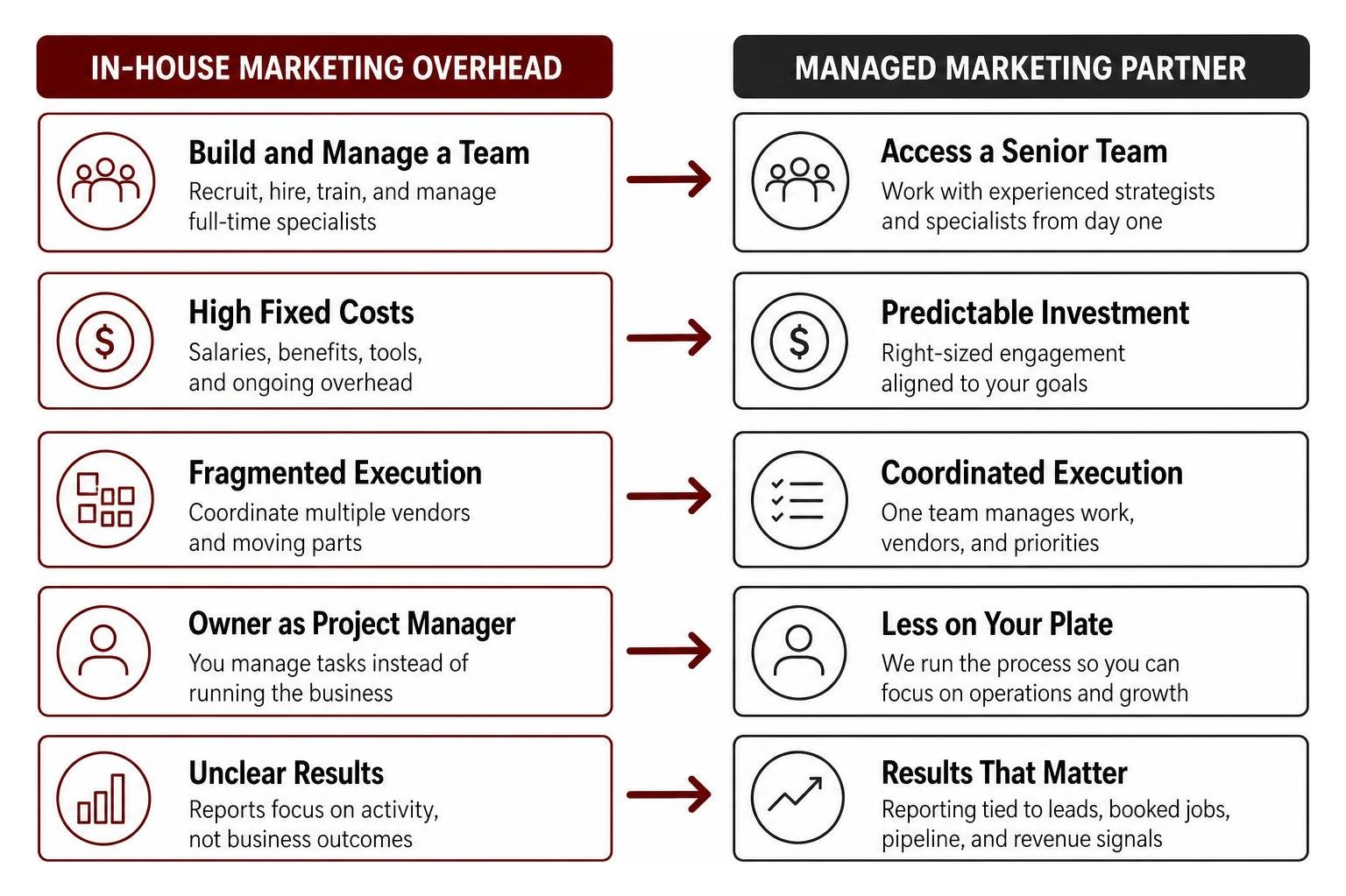
A managed model gives you access to senior marketing leadership and people to carry out the work. It can connect marketing decisions to crew availability and the service calls or replacement jobs you want to book.
Core Marketing Functions an Outsourced Marketing Department for Contractors Manages
A managed partner reviews your service mix and target markets to build a marketing plan that fits the work your team can handle. Rather than pushing every possible tactic, the team chooses marketing methods that support the jobs you want to book and have capacity to take on.
An outsourced department coordinates several kinds of work:
- Commercial Positioning: Defining why residential or commercial property owners should choose your business over local alternatives.
- Marketing Strategy: Planning spending, promotion timing, and targets for winning new customers around the work your crews can handle each season.
- Local Visibility: Managing local business listings, asking customers for reviews, and creating content about the areas you serve so property owners can find your team when they need service.
- Conversion Optimization: Structuring websites, estimate request workflows, and landing pages (web pages built for a specific campaign) to help visitors call or schedule a visit.
- Branded Materials: Producing consistent branded materials, vehicle wrap templates, equipment stickers, sales presentation folders, and estimate sheets.
- Revenue Operations and Tracking: Connecting phone tracking numbers (numbers that show which marketing effort prompted a call), web forms, and CRM records that track prospects from first inquiry through booking to see which campaigns produce completed jobs.
- ChatGPT Advertising: The OODA Group can help clients advertise on ChatGPT.
Structuring an Outsourced Marketing Department for Contractors by Company Size
A trade company generating $2M annually may need a different setup than a commercial or multi-location residential contractor generating $15M+. Revenue is a starting point; locations, service mix, and crew capacity also shape the work required.
For businesses focused on regional growth, specialized Contractor Construction Marketing addresses trade-specific requirements, such as commercial bid cycles or residential emergency calls.
- $1M to $3M Revenue: Possible priorities include local search presence, campaigns that ask customers to call or request an estimate for high-margin services, basic call tracking, and maintaining a website that helps visitors call or request an estimate.
- $3M to $7M Revenue: Possible priorities include coordinating campaigns across marketing methods, such as email and paid ads, contacting past customers about repeat service, automating CRM tasks such as follow-up reminders, managing reviews, and coordinating more closely with dispatch.
- $7M+ Revenue: If you operate across several territories, possible priorities include coordinating the work, keeping branding consistent across branches, advertising technician openings, and connecting campaign and accounting data to estimate which marketing efforts contribute to revenue.
Key Service Capabilities to Manage Under a Central Strategy
Piecemeal marketing vendors often operate in isolation. A pay-per-click (PPC) agency, which manages ads charged by the click, might drive clicks without checking whether the dispatch team can handle the calls, while a search engine optimization (SEO) vendor, which works to improve visibility in unpaid search results, might build traffic that never requests an estimate.
A managed marketing partner brings these functions under one plan, with one team responsible for coordinating the work:
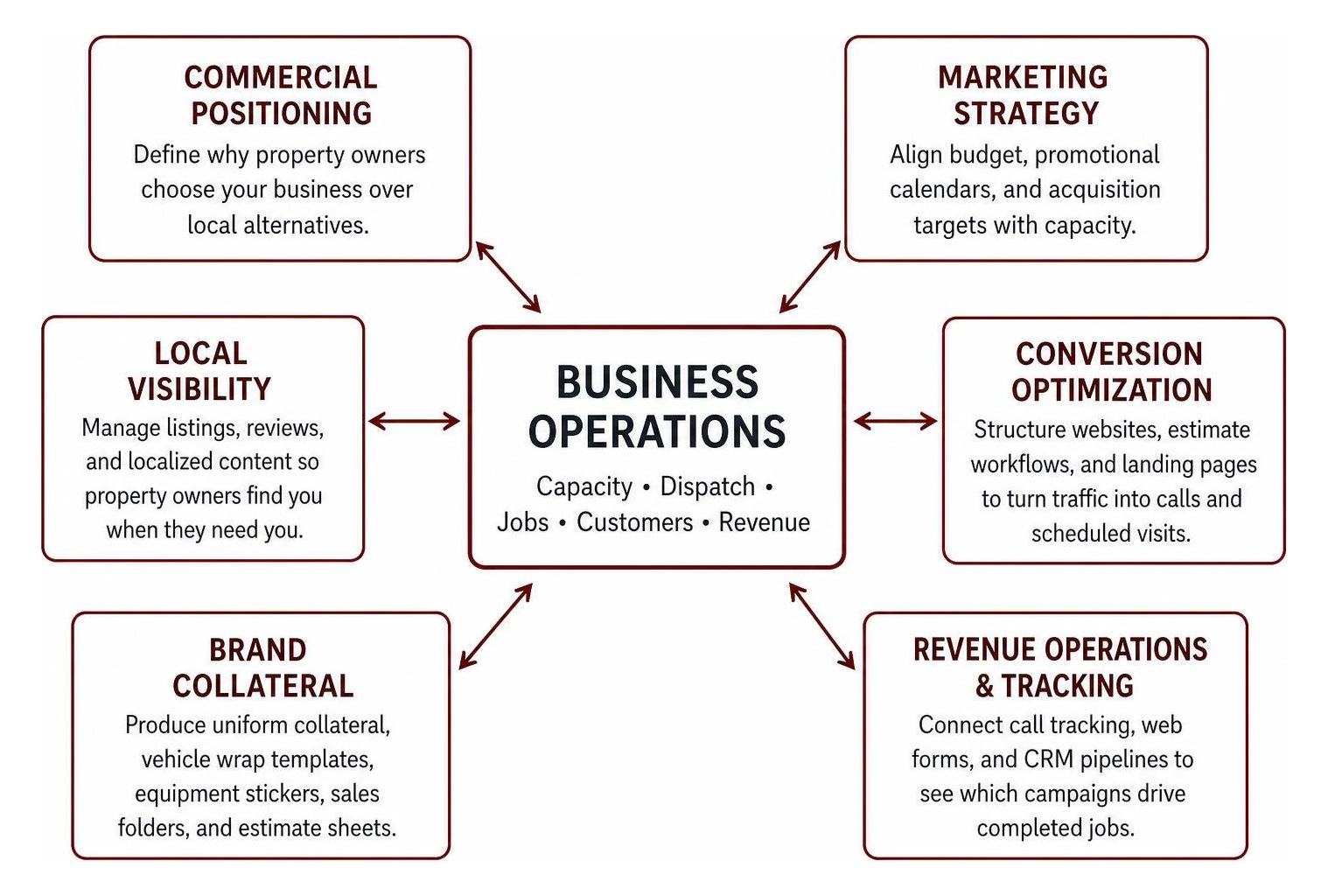
By managing these services collectively, marketing activity can adjust when seasonal demand shifts, such as transitioning from heating repairs to cooling maintenance, to help align spending with available technician capacity.
Evaluating Marketing Engagement Models: Freelancers, Agencies, and Managed Partners
Contractors have several options when outsourcing marketing. The choice affects how much you manage yourself, how quickly work gets done, and how well it supports your business goals.
Vetting an Outsourced Marketing Department for Contractors on Industry Knowledge
A generalist team can miss trade-specific realities, such as dispatch capacity or seasonal demand. When evaluating external partners, vet them across practical contractor realities:
- Dispatch and Scheduling Realities: Do they understand the cost of a missed call, sending a truck to a job, and the importance of answering the phone promptly?
- Trade Terminology: Can their copywriters distinguish between a basic system tune-up, a ductless mini-split installation, a service panel upgrade, or commercial tenant improvements without hand-holding?
- Seasonal Demand Shifts: Do they adjust campaigns ahead of quieter periods between peak heating and cooling seasons, or wait until call volumes drop?
- Service Radius Control: Do they know how to set up campaigns to avoid generating leads outside your primary zip codes?
Model Comparison for Contracting Businesses
The table below outlines common outsourcing models and how they function in day-to-day operations:
| Engagement Model | Core Strengths | Operational Drawbacks | Best Fit For |
|---|---|---|---|
| Task Platforms (Fiverr, Upwork) | Can offer low upfront costs and quick turnaround for isolated visual tasks; check each provider’s scope and schedule. | Strategy, coordination, and quality checks may remain your responsibility unless included in the scope. | One-off asset creation like redrawing a logo or converting a graphic into a file that stays sharp at any size. |
| Specialist Providers (SEO or PPC Only) | Deep focus in one marketing method, such as unpaid search or paid search ads. | You may need to coordinate their work with other marketing methods and agree on who tracks inquiries through to booked jobs. | Companies with an experienced in-house marketing director managing vendors. |
| Traditional Ad Agencies | Broad creative capabilities and campaign production. | Retainers (ongoing fees for an agreed scope of work) may include services you do not need; agree on measures tied to booked work and profit per job. | Large enterprise businesses with wide brand awareness budgets. |
| Managed Marketing Partner | One team sets priorities, coordinates the work, understands your crew capacity, and gives you one person to contact. | Requires sharing information about your workload and capacity, providing CRM data access, and staying in touch with your staff. | Established contracting companies seeking full marketing management without hiring internal teams. |
Working with five disconnected vendors often feels like trying to run a job site where the framing crew, plumbers, and electricians refuse to speak to one another. A managed partner coordinates the entire effort under one clear plan.
Getting Started and Keeping Marketing Accountable
Shifting to an outsourced department takes a clear handoff plan to keep current marketing running and protect your accounts, website, and other business assets.
A successful handoff to your new marketing team follows a deliberate sequence:
- Asset Ownership and Access: Confirm that your business owns and can access its digital assets, Google Business Profiles (your business listings on Google Search and Maps), ad accounts, domain registrations (the records that reserve your website address), tracking numbers, and website hosting (the service that stores and serves your website’s files).
- Current System Review: Evaluate existing tools using the Keep, Connect, Replace, or Retire framework to identify redundant software subscriptions.
- Coordination With Your Team: Set up regular communication with dispatchers, estimators, and project managers to review incoming inquiries and feedback.
- First 90-Day Plan: Set priorities for the first 90 days, focusing first on high-margin services or simple website changes that help visitors call or request an estimate.
Files and Business Information Your Marketing Team Needs
Give your marketing team a shared folder with the following information so they can do the work correctly without checking with you at every step:
- Brand Standards: Vector logo files (files that stay sharp when resized), color palettes, approved fonts, and standard truck graphics.
- Service Catalogs & Pricing Guides: Defined service boundaries, target job sizes, prohibited work types, and margin expectations.
- Ideal Customer Profiles: Clear descriptions of target property types, neighborhood targets, and commercial project parameters.
- Access Permissions: Administrative credentials for local listings, analytics tools that measure website visits and visitor actions, CRMs, call tracking systems, and content management systems (CMS), the tools used to update your website.
Tracking Results and Knowing When to Reassess Your Plan
Hold marketing accountable with numbers tied to booked work rather than attention alone. Clicks, impressions (the number of times an ad is shown), and raw form submissions do not pay technician wages.
Prioritize these metrics during performance reviews:
- Cost Per Qualified Lead (CPQL): The total marketing expense divided by legitimate inquiries from customers within your service area.
- Booking Rate: The percentage of qualified inbound inquiries that your office successfully schedules for an estimate or service call.
- Customer acquisition cost (CAC): Total blended marketing investment required to win a paying customer across specific service categories.
- Pipeline Value and Completed Job Revenue: Track the estimated value of potential jobs still moving toward a sale separately from revenue from completed jobs linked to your marketing.
Tracking these numbers helps you refine campaigns to Book More Jobs by shifting budget toward high-margin replacements and profitable commercial contracts.
If your provider fails to deliver transparent reporting, blames your dispatch team for poor lead quality without reviewing recordings, or locks you out of your own advertising accounts, reassess the engagement immediately.
Frequently Asked Questions About Contractor Marketing Management
How quickly can a contracting firm transition to an outsourced marketing model?
Transition timing depends on account access, existing systems, and the work being transferred. The first phase focuses on listing your existing marketing accounts and materials, reviewing existing campaigns, gaining system access, and setting up tracking to show which marketing efforts bring in inquiries and booked jobs. Ask how the partner will keep active campaigns running during setup to reduce the risk of interrupting incoming inquiries. Once those reviews and tracking are in place, the partner refines how you present your business, improves your website to help visitors call or request an estimate, and adjusts ad strategies.
How does an external marketing department collaborate with internal dispatch and sales?
Your marketing team needs access to the right information and a regular time to review it with dispatch and sales. Ask whether the partner can review call recordings, lead status updates, and booking outcomes in your call-tracking platform and CRM (such as ServiceTitan, FieldEdge, or Housecall Pro), and what account access or connections between software tools are needed. Use those reviews to discuss crew availability and whether inquiries fit the work you want. That gives the partner information to adjust campaigns when a crew has room for more jobs.
When should a contractor reassess or replace an underperforming provider?
Reassess your provider if their plan keeps missing your business goals, account access or reporting is unclear, or inquiries have not improved for more than a quarter and they cannot explain what is going wrong. Warning signs include withholding administrative access to your ad accounts, reporting only on how often ads are shown rather than qualified inquiries, and failing to plan around your trade’s busy and quiet seasons.
Choosing a Marketing Partner That Can Grow With Your Business
As your business grows, you need systems you can manage and rely on. Look for a partner who can coordinate the work, adjust campaigns to your crew capacity, and show whether your marketing spend is bringing in the right inquiries. The arrangement should leave you with less coordination work, not another team to chase.
Learn more About Us and our methodology. At The OODA Group, we use the Observe, Orient, Decide, Act framework to manage your marketing. We look at how customers see your business, where your team has room for more work, and which marketing actions fit the jobs you want to book.
Through our Keep, Connect, Replace, or Retire framework, we review your current tools and vendors for waste while keeping assets that already perform well. Whether you need full marketing management or a Fractional CMO, a part-time chief marketing officer who leads your marketing strategy, choose a scope that fits the gaps in your business. A managed partner can give you senior marketing leadership and a team to carry out the plan without building a full in-house department.