

How Fast Should Contractors Respond to Leads to Maximize Booked Revenue?
According to research published in the Harvard Business Review, 78% of customers buy from the company that responds first. In home services, where customers are often looking for immediate help or comparing multiple vendors from local search results, response speed is frequently the deciding factor before pricing or reviews even come into play.
When a homeowner submits a form or makes a call, they are at the peak of their intent. If they do not hear back immediately, they do not wait by the phone. They move down the list to the next provider.
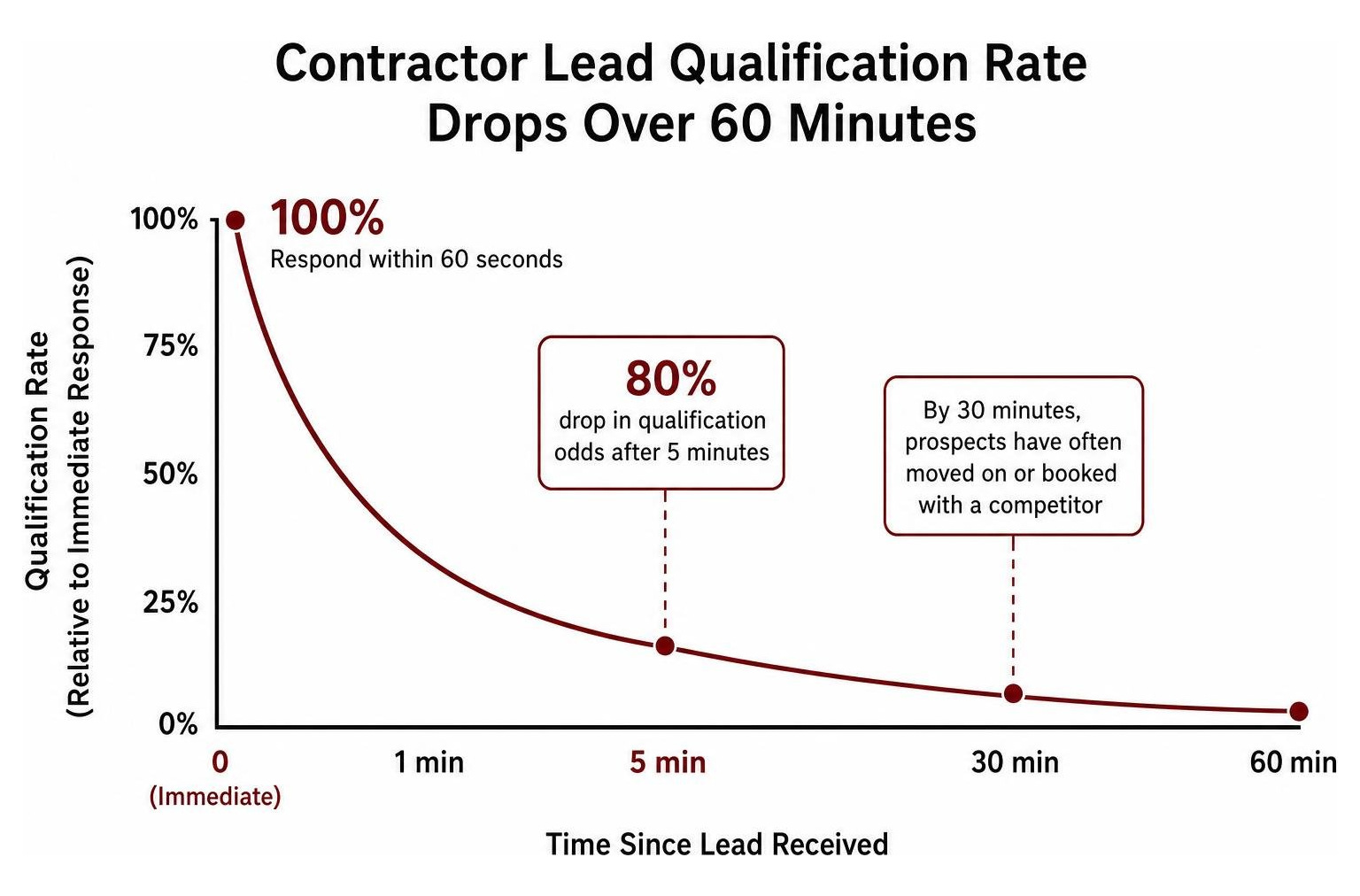
The speed-to-lead data reflects real operational mechanics. When you contact an inquiry within 60 seconds, you catch the property owner while their browser tab is still open or while they still have their phone in hand.
According to research from LeanData, qualification odds drop by 80% after just five minutes. By the time 30 minutes pass, the prospect has often left their desk, stepped into a meeting, or already scheduled an estimate with a competitor.
The financial cost of slow response becomes obvious when you look at the math across a typical month. Consider an established trade contractor generating 80 leads per month with an average ticket of $1,400.
Contractors responding within two minutes convert roughly 62% of those opportunities into booked work. At the 42-hour industry average response time identified by Harvard Business Review audits, conversion rates plunge to roughly 28%.
For that 80-lead shop, the difference between responding in two minutes and lagging behind is 27 lost jobs every month. That represents over $37,800 in uncaptured monthly revenue, or roughly $381,000 in lost top-line revenue over a single year. You can review more on the underlying data through industry lead response benchmark data and scientific research on contractor speed to lead.
| Response Time Window | Lead Qualification Multiplier | Average Lead-to-Booked Conversion Rate | Monthly Revenue (80 Leads at $1,400 Avg Ticket) |
|---|---|---|---|
| Under 1 Minute | Peak Baseline (391% Lift vs Slow Response) | 65% | $72,800 |
| Under 5 Minutes | 21x Higher vs 30 Minutes | 58% – 62% | $64,960 – $69,440 |
| 10 to 30 Minutes | 80% Drop from Peak Odds | 35% – 40% | $39,200 – $44,800 |
| 42+ Hours (Industry Avg) | Baseline Low | 28% | $31,360 |
How Fast Should Contractors Respond to Leads in Emergency vs. Non-Emergency Trades?
Not all trade inquiries decay at the exact same rate. The required response window changes based on customer urgency and project scope.
- Emergency Plumbing and HVAC Failures: Decay window is 5 to 10 minutes. A burst pipe or a broken AC unit in peak summer forces immediate action. If you do not answer live or return the call in minutes, the job is gone.
- Storm-Damaged Roofing: Decay window is 5 to 15 minutes. Homeowners dealing with active leaks contact several local roofers simultaneously.
- Residential Electrical Repairs: Decay window is 15 to 30 minutes for standard diagnostic visits, and under 5 minutes for safety hazards or power loss.
- High-Ticket Remodeling and Additions: Decay window is 30 to 60 minutes. While a kitchen remodel inquiry will not hire someone else in five minutes, quick engagement establishes professionalism and secures the first site visit on the calendar.
- Custom Home Building and Pool Construction: Decay window is 2 to 4 hours. These buyers expect consultative conversations, but delayed outreach still signals poor project management.
The Google Business Profile Shift: What Direct Response Signals Matter Now
In July 2024, Google officially discontinued Google Business Profile (GBP) chat. Contractors who built workflows around native GBP text messaging had to pivot.
Google still tracks customer interaction signals closely. For local search visibility and Google Local Services Ads (LSA), your operational responsiveness remains a ranking factor. Platforms prioritize service providers who maintain high answer rates on call tracking numbers and short pickup delays.
Fast responses to customer reviews and rapid follow-through on LSA direct bookings signal an active, trustworthy business. Integrating these response protocols with systematic SEO management ensures that the visibility you earn on search engines translates directly into connected calls.
Why 27% of Home Service Inquiries Fail to Connect (And the Cost of Missed Calls)
Roughly 27% of all inbound phone calls to home service businesses go completely unanswered. In the trades, each missed call represents an average of $1,200 in unrealized job revenue.
Field reality explains why this happens. Owners are on job sites, technicians are focused on complex installations, and office staff are balancing dispatch boards with supply houses.
Data from NADA indicates that 56% of inbound service inquiries arrive after standard business hours (between 5:00 PM and 8:00 AM) or over the weekend. When these after-hours calls roll to a generic voicemail, homeowners hang up and call the next listing.
Leaving high-intent opportunities to chance undermines your paid digital advertising campaigns, driving up your actual acquisition cost per closed job.
The Handoff Trap: Why an Automated Text Without a Fast Callback Destroys Trust
Many contractors believe they have solved speed to lead by turning on a generic auto-reply text. However, a fast automated message without an operational handoff actually damages customer trust.
Consider the customer experience: a homeowner submits a request, receives an automated text saying, “We will call you in 5 minutes,” and then hears nothing for four hours. That broken promise proves your business lacks internal follow-through before the first estimate is even written.
An automated first touch buys you a brief window of attention, not a closed job. It must connect immediately to a human callback or a functional scheduling flow.
Building a 24/7 Response Engine: Three Automation Tiers for Growing Contractors
Building a reliable intake system does not require overhauling your entire operation overnight. Most growing contractors select from three practical tiers based on call volume, crew capacity, and budget.
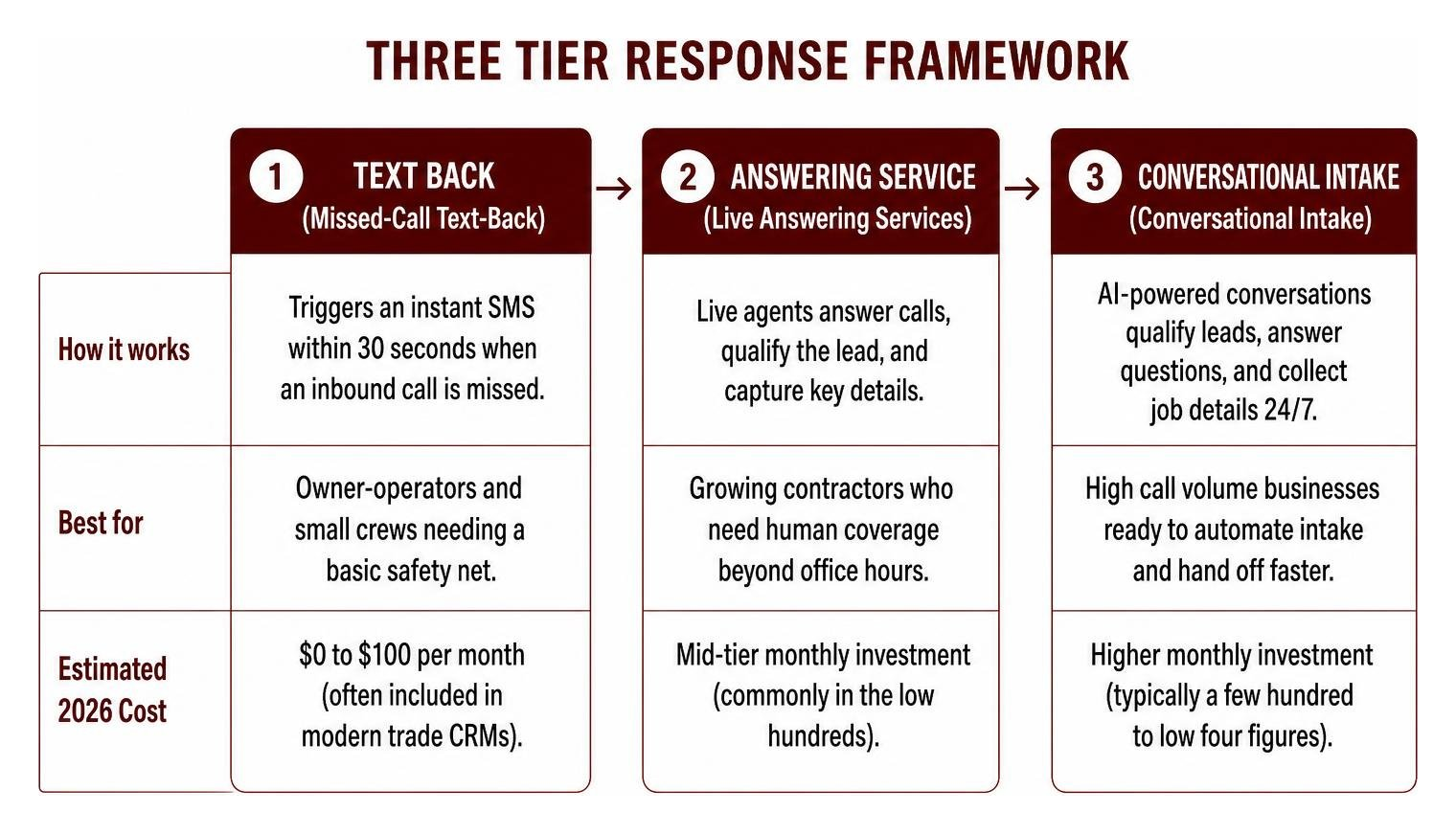
- Tier 1: Missed-Call Text-Back (Low Cost / Built into CRMs)
- How it works: Triggers an instant SMS within 30 seconds when an inbound call is missed.
- Best for: Owner-operators and small crews needing a basic safety net.
- Estimated 2026 Cost: $0 to $100 per month (often included in modern trade CRMs).
- Tier 2: Live Answering Services (Mid-Market Dispatch)
- How it works: Third-party live operators answer overflow calls 24/7, collect basic scope details, and log the job directly into your dispatch software.
- Best for: Established plumbing, roofing, or electrical shops running multiple trucks.
- Estimated 2026 Cost: $200 to $600 per month depending on call minute volume.
- Tier 3: Conversational AI Intake Agents (24/7 Direct Booking)
- How it works: Voice and SMS intake agents that hold natural conversations, answer common service questions, qualify urgency, and book estimate slots directly into the technician schedule.
- Best for: High-volume emergency service businesses needing zero-second response times.
- Estimated 2026 Cost: $79 to $250 per month.
Integrating these intake channels provides a clear structure to book more jobs without overworking your field technicians or missing after-hours emergencies. For deeper trade data, see the research breakdown on lead response time statistics for contractors.
The Three-Element Text Framework That Keeps Homeowners Engaged
If you use automated SMS intake, every initial outbound message should include three specific components:
- Immediate Acknowledgment: Confirm you received their specific inquiry.
- Clear Expectation: State exactly when a team member will call them.
- A Single Concrete Next Step: Ask one question to categorize the issue.
This structure acknowledges the issue, filters true emergencies from general estimates, and keeps the homeowner from contacting a competitor while waiting for your call.
A 5-Day Operational Audit: How to Measure and Cut Your Response Delays
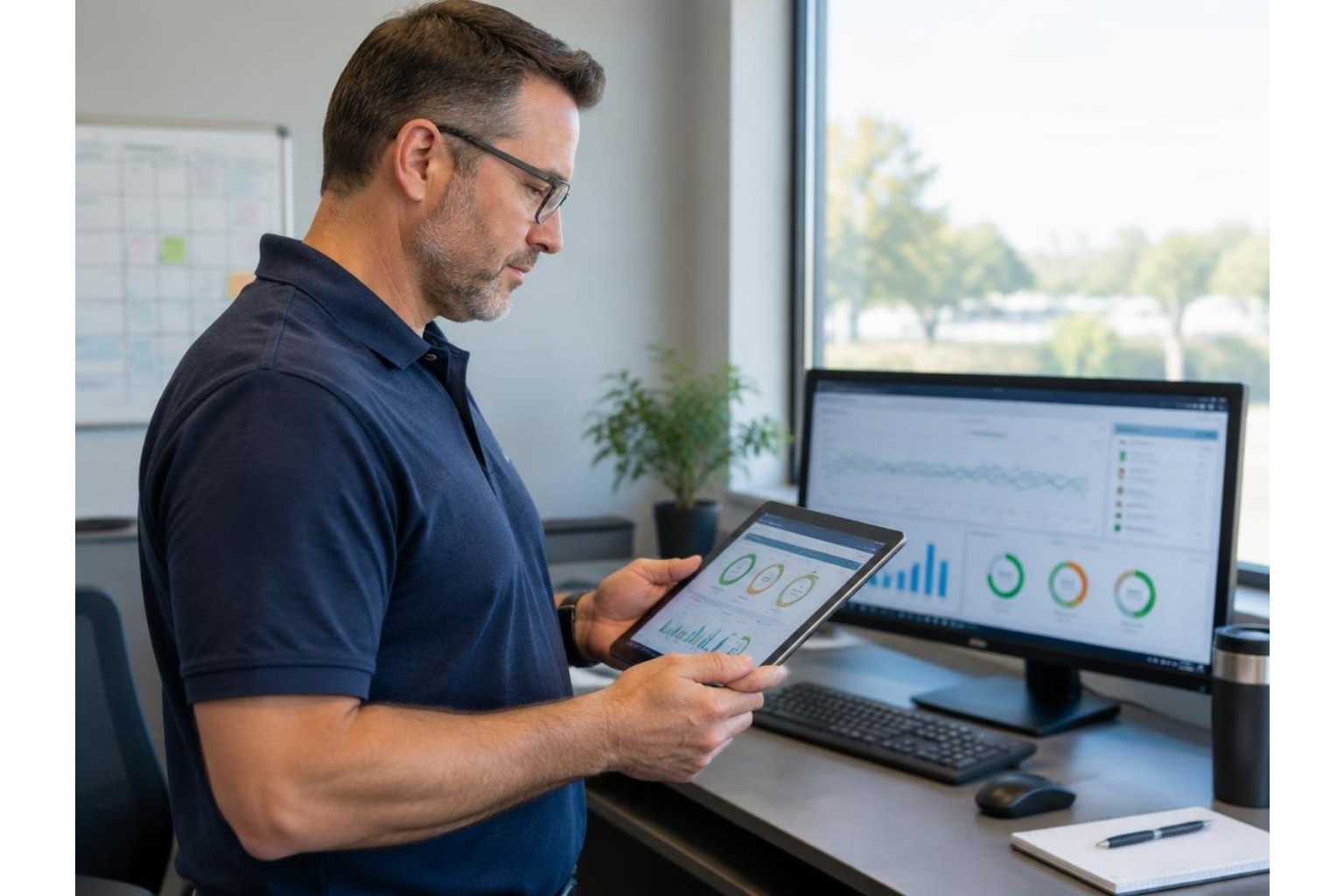
Before investing in new software or call services, measure your current baseline. For five consecutive business days, track your numbers across four operational metrics:
- Missed Call Volume: The raw count of inbound calls that go to voicemail during and after business hours.
- Average Callback Delay: The elapsed time between a missed call or form submission and a live human callback attempt.
- First-Touch Inbound Form Speed: The time it takes for an inquiry from your website or directory listing to receive a response.
- After-Hours Capture Rate: The percentage of evening and weekend inquiries that result in a booked appointment rather than a lost lead.
Use your CRM timestamps to pull accurate data rather than relying on memory. Once you identify where your intake stalls, you can establish clear internal service-level agreements (SLAs) for your office staff. You can also review trade-specific workflows in guides like HVAC lead response time challenges and why the 5-minute rule wins jobs.
Connecting your intake process to a clear marketing strategy ensures your marketing investment generates booked jobs rather than lost calls.
Frequently Asked Questions About Contractor Response Times
How Fast Should Contractors Respond to Leads Arriving After Regular Business Hours?
For non-emergency trades, acknowledge after-hours inquiries via automated SMS within 60 seconds, state your morning operating hours, and place the first callback by 8:15 AM the next business day. For emergency HVAC, plumbing, or electrical trades, implement 24/7 call routing or AI intake to qualify and dispatch on-call technicians within 15 minutes.
Do Automated Text Responders Frustrate High-Ticket Remodeling Clients?
No, as long as the message is professional, sets honest expectations, and avoids sounding like a chatbot. High-ticket clients appreciate knowing their inquiry was received, provided a qualified project consultant follows up with a phone call within the promised window.
What Is the Single Fastest Way to Lower Cost Per Booked Job Without Increasing Ad Spend?
Eliminate unanswered calls and cut response times on existing leads to under five minutes. When conversion rates increase from 28% to over 50% through rapid response, your effective cost per booked job drops significantly without buying additional ad clicks. Further tactical benchmarks can be found in speed-to-lead for contractors in the first 60 seconds.
Eliminate Response Delays and Turn More Inquiries into Booked Work
Marketing performance does not end when a lead form is submitted or a phone rings. For contracting businesses, real growth depends on connecting your marketing spend directly to dispatch capacity, estimate completion, and closed revenue.
The OODA Group works as a dedicated managed marketing partner for established home-service and commercial contractors. Using our Observe, Orient, Decide, Act framework, we help you evaluate your entire acquisition pipeline, identifying what assets to keep, connect, replace, or retire.
If you are ready to identify where your marketing pipeline is leaking revenue, take our Marketing Mess Diagnostic to evaluate your lead acquisition, tracking, and conversion performance across your service territory with our contractor and construction marketing solutions.